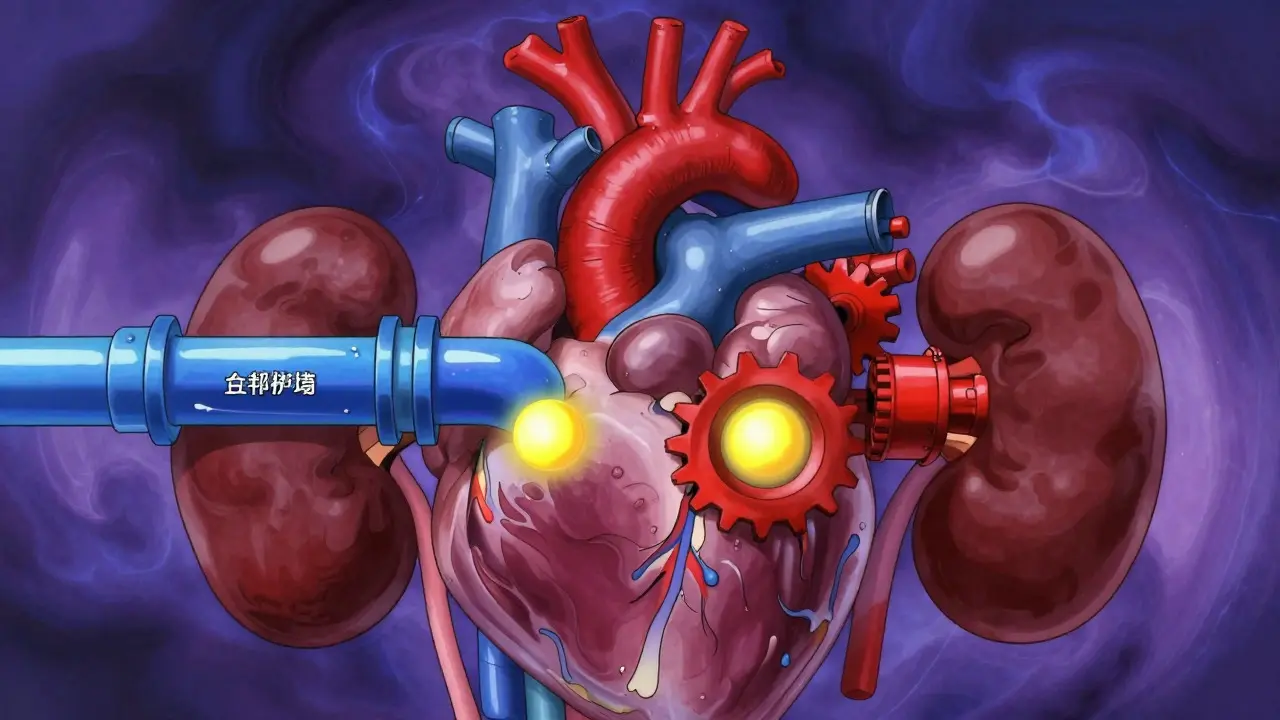

Hyperkalemia Risk Assessment Tool
Instructions: Select the patient characteristics that apply to calculate their estimated risk of severe hyperkalemia (>6.0 mmol/L) when starting this combination therapy.
Age > 70 Years
Higher baseline riskRenal Impairment
eGFR < 60 or Cr > 1.5Diabetes Mellitus
Hyporeninemic riskBaseline K+ > 5.0
Pre-existing elevationNYHA Class III/IV
Poor renal perfusionNSAIDs / K+ Supplements
Concurrent usageRisk Assessment Result
Monitoring Schedule
- Initial Check: 7–14 days after start
- Ongoing: Every 4 months
Prescribing ACE inhibitors alongside spironolactone is a standard move for treating severe heart failure, but it comes with a hidden trap. You are essentially stacking two drugs that both raise potassium levels in the blood. The result? A significantly higher risk of hyperkalemia, a condition where serum potassium exceeds 5.0 mmol/L. If left unchecked, this can lead to life-threatening cardiac arrhythmias.
This isn't just theoretical. Since the landmark Randomized Aldactone Evaluation Study (RALES) in 1999 proved that spironolactone saves lives in heart failure patients, clinicians have had to balance that mortality benefit against the danger of high potassium. The good news is that with strict monitoring and smart dose adjustments, you can keep patients on this life-saving combination safely.
Why This Combination Raises Potassium Levels
To understand the hazard, you need to look at how these drugs work in your body. ACE inhibitors block the production of angiotensin II, which indirectly reduces aldosterone secretion. Aldosterone is the hormone responsible for telling your kidneys to excrete potassium. When you lower aldosterone, potassium stays in the blood.
Spironolactone takes it a step further. It is a mineralocorticoid receptor antagonist (MRA) that directly blocks aldosterone receptors in the kidney. So, while the ACE inhibitor cuts off the supply of aldosterone, spironolactone blocks the doors where aldosterone would normally act. This creates a synergistic effect that severely impairs potassium homeostasis.
In simple terms, you are hitting the brakes on potassium excretion from two different angles. For most people with healthy kidneys, this is manageable. But for those with existing renal issues or diabetes, the system can quickly get overwhelmed.
The Real-World Risk vs. Clinical Trials
Clinical trials give us a controlled view of safety, but real-world practice is messier. The RALES trial showed that patients on spironolactone had a 13.5% risk of hyperkalemia compared to placebo when they reached the target dose of 25 mg/day. However, a 2015 study published in Pharmacoepidemiology and Drug Safety analyzed data from over 134,000 heart failure patients in Germany and found the risk was "much stronger in real-life practice" than in trials.
Why the difference? Clinical trials exclude many high-risk patients and enforce strict monitoring schedules that don't always happen in everyday clinics. The German study found that patients with pre-existing renal impairment (eGFR <60 mL/min/1.73m²) faced a 3.2-fold higher risk of hyperkalemia when on this combination therapy. This gap between trial data and reality means you cannot rely solely on trial statistics to gauge patient safety.
| Risk Factor | Threshold / Criteria | Impact on Risk |
|---|---|---|
| Renal Insufficiency | Serum creatinine >136 µmol/L (1.5 mg/dL) | Dramatically increases retention of potassium |
| Age | Over 70 years | 10% risk of severe hyperkalemia (>6.0 mmol/L) after 1 year |
| Diabetes Mellitus | History of diabetes | Higher risk of renovascular disease and hyporeninemic hypoaldosteronism |
| Baseline Potassium | >5.0 mmol/L before starting therapy | Predicts rapid escalation to dangerous levels |
| Heart Failure Severity | NYHA Class III or IV | Associated with worse renal perfusion and higher drug accumulation |

Monitoring Protocols: What Guidelines Say
You cannot manage what you do not measure. The American College of Cardiology/American Heart Association (ACC/AHA) and the Heart Failure Society of America (HFSA) provide clear guidelines for monitoring this combination. Here is the practical workflow:
- Baseline Check: Measure serum electrolytes and creatinine before prescribing anything.
- Initial Follow-up: Test blood levels 7-14 days after starting therapy or any dose increase.
- High-Risk Patients: If the patient has baseline potassium >5.0 mmol/L, renal insufficiency, or is over 70, test within 3-5 days instead.
- Ongoing Monitoring: Check every 4 months once stable.
The European Society of Cardiology adds another layer: do not increase doses more frequently than every two weeks outside of a hospital setting. This slow titration allows the kidneys time to adjust and gives you early warning signs if potassium starts climbing.
A key insight from recent guidelines is that a rise in creatinine up to 30% and a fall in eGFR up to 25% is acceptable during the initiation phase, provided potassium remains stable. This reflects the hemodynamic changes expected when blocking the renin-angiotensin-aldosterone system (RAAS). Don't panic at a slight bump in creatinine; focus on the potassium.
Managing Elevated Potassium: Do Not Stop Automatically
Here is where many clinicians make a mistake. They see a potassium level of 5.2 mmol/L and immediately stop the spironolactone. This might cost the patient their survival benefit. Dr. Bertram Pitt, principal investigator of the RALES trial, has argued strongly against automatic discontinuation for mild hyperkalemia.
Data shows that spironolactone maintains its mortality benefit until potassium levels exceed 5.5 mmol/L. So, here is a tiered approach to management:
- Mild Hyperkalemia (5.1-5.5 mmol/L): Reduce the spironolactone dose to 12.5 mg daily. Continue the ACE inhibitor. Recheck labs in one week. Often, the lower dose keeps potassium in check while preserving some clinical benefit.
- Moderate Hyperkalemia (5.6-6.0 mmol/L): Temporarily discontinue spironolactone. Monitor closely. Consider dietary potassium restriction (<2,000 mg/day), though evidence for diet alone is limited. Restart at a lower dose only if levels normalize and the benefit outweighs the risk.
- Severe Hyperkalemia (>6.0 mmol/L): Immediate discontinuation of both agents if possible, or at least the MRA. Initiate emergency management protocols (calcium gluconate, insulin/glucose, etc.) as per ACLS guidelines.
Remember, the goal is to keep the patient alive from heart failure without killing them from an arrhythmia. It is a tightrope walk, but staying on the medication at a reduced dose is often safer than stopping entirely.

Newer Alternatives and Future Directions
If spironolactone proves too risky for a specific patient, you now have alternatives. Finerenone is a non-steroidal MRA that has shown promise. The FIDELIO-DKD trial (2020) demonstrated that finerenone caused significantly less hyperkalemia than spironolactone when combined with ACE inhibitors in diabetic kidney disease patients. The absolute risk reduction for hyperkalemia requiring drug discontinuation was 6.5%.
However, cost is a major barrier. As of 2023, generic spironolactone costs about $4.00/month, while finerenone can run around $450/month under Medicare Part D. For most patients, spironolactone remains the first-line choice due to extensive outcome data and affordability.
Another emerging strategy involves adding SGLT2 inhibitors. The 2022 EMPA-HEART study suggested that SGLT2 inhibitors might mitigate hyperkalemia risk by up to 22% when added to ACE inhibitor/spironolactone regimens. While this needs larger validation, it points toward a future where multi-drug synergy helps manage side effects rather than just compounding them.
Conclusion: Vigilance Pays Off
The combination of ACE inhibitors and spironolactone is a double-edged sword. It offers a proven 30% reduction in mortality for severe heart failure, but it demands respect for the risk of hyperkalemia. By identifying high-risk patients early, adhering to strict monitoring schedules, and adjusting doses rather than abandoning therapy at the first sign of elevated potassium, you can maximize benefits while minimizing harm. Don't let fear of lab values rob your patients of life-saving treatment-but don't ignore the warnings either.
What is the main risk of taking ACE inhibitors with spironolactone?
The primary risk is hyperkalemia, or high blood potassium levels. Both drugs reduce the body's ability to excrete potassium, which can lead to dangerous heart rhythms if levels exceed 6.0 mmol/L.
When should I check potassium levels after starting this combination?
For standard-risk patients, check 7-14 days after initiation. For high-risk patients (age >70, renal insufficiency, diabetes, or baseline potassium >5.0 mmol/L), check within 3-5 days.
Should I stop spironolactone if potassium rises to 5.2 mmol/L?
Not necessarily. Guidelines suggest reducing the spironolactone dose to 12.5 mg daily rather than stopping completely, as the mortality benefit persists until potassium exceeds 5.5 mmol/L.
Is finerenone a safer alternative to spironolactone?
Yes, finerenone causes less hyperkalemia. However, it is significantly more expensive ($450/month vs $4/month) and is typically reserved for patients who cannot tolerate spironolactone despite dose adjustments.
How does age affect the risk of hyperkalemia?
Patients over 70 years old have a higher risk of severe hyperkalemia (>6.0 mmol/L), with studies showing a 10% incidence rate after one year of therapy. Age-related decline in kidney function exacerbates the drug interaction.