

When a patient gets a biosimilar instead of the original biologic drug, they’re not getting a copy like a generic pill. Biosimilars are made from living cells - not chemicals - and even tiny changes in how they’re made can affect how the body reacts. That’s why adverse event monitoring for biosimilars isn’t just important - it’s built into the system from day one. Unlike generics, which are chemically identical to their brand-name counterparts, biosimilars are highly similar but not exact matches. This means regulators and doctors can’t assume safety is identical. They need to watch closely - and track every reaction back to the exact product used.
Why Biosimilars Need Special Tracking
Think of a biosimilar like a handmade sweater that looks just like one made by a famous designer. Same pattern, same wool, same color - but maybe the stitch tension is slightly off, or the dye batch changed. It works fine for most people. But for someone with sensitive skin, that small difference might cause a rash. That’s the risk with biosimilars. Their complexity makes them prone to immunogenicity - the body seeing them as foreign and reacting. This can lead to reduced effectiveness, allergic responses, or even dangerous immune reactions like neutralizing antibodies that attack both the drug and the body’s own proteins.
Because of this, every biosimilar must come with a detailed Risk Management Plan (RMP). These aren’t just paperwork. They’re active, living documents that require manufacturers to monitor how patients respond after the drug hits the market. The goal? Catch any safety signal early - especially if it’s happening more often with the biosimilar than the original. If a pattern emerges, regulators can act fast: update labels, issue warnings, or even pull the product.
How Adverse Events Are Collected and Tracked
There are two main ways adverse events are caught: by people reporting them, and by systems scanning data automatically.
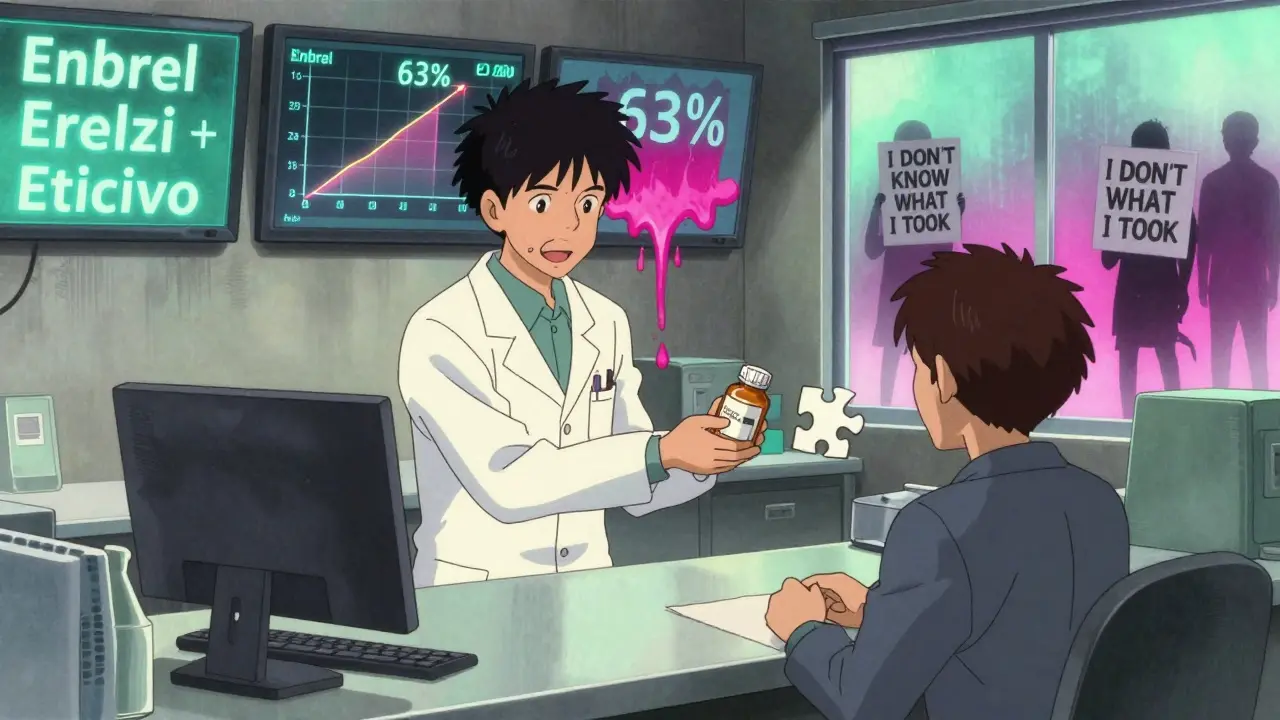
Spontaneous reporting is the backbone. Doctors, pharmacists, nurses, and even patients can report side effects to national databases like the FDA’s FAERS or EMA’s EudraVigilance. In the U.S., serious events must be reported within 15 days. Non-serious ones have 90 days. But here’s the catch - if a report says "etanercept" without specifying whether it’s Enbrel (the reference) or a biosimilar like Erelzi or Eticovo, it’s useless for tracking. That’s why product identification is everything.
In the U.S., biosimilars get a four-letter suffix - like "-abda" for Adalimumab-adbm. It’s meant to help distinguish them. But in practice, many providers still don’t use it. A 2022 survey found 63% of U.S. physicians were confused about how to document biosimilar reactions. Some just write the brand name of the original drug. Others don’t note the manufacturer at all. That makes it nearly impossible to tell if a reaction came from the biosimilar or the reference product.
Canada and Europe handle this differently. Health Canada requires exact brand and manufacturer names in every report. Spain’s electronic health records now force pharmacists to select the specific biosimilar from a dropdown - and since 2020, reporting accuracy jumped from 58% to 92%. That’s not magic. It’s system design.
Active Surveillance: Looking for Signals Before They Become Problems
Waiting for someone to report a side effect is like waiting for a fire alarm to go off. Active surveillance is like installing smoke detectors everywhere.
The FDA’s Sentinel Initiative scans millions of electronic health records and insurance claims across U.S. hospitals and clinics. It looks for patterns: Are patients on a specific biosimilar having more infusion reactions? Are more people being hospitalized for lupus-like symptoms after switching to a new adalimumab biosimilar? This system doesn’t rely on human memory or paperwork. It finds signals in real-time data.
Europe is ahead with AI. In 2022, the EMA launched VigiLyze - an artificial intelligence tool that scans 1.2 million new adverse event reports every year. It flags unusual clusters, compares them to historical data, and identifies potential safety signals with 92.4% accuracy. That’s faster, smarter, and more reliable than manual review.
But even the best systems have limits. If ten biosimilars all target the same reference drug - say, infliximab - and they all have similar names, coding, or lack batch-level tracking, it becomes a statistical mess. A 2015 study warned this could make it impossible to tell which product caused a reaction. That’s exactly what’s happening now in the U.S., where 10 new biosimilars were approved in 2022 alone.
The Tracking Gap: When Patients Don’t Know What They’re Taking
Here’s the biggest problem no one talks about: patients often don’t know whether they’re getting the original drug or a biosimilar.
A 2022 survey by the Arthritis Foundation found 41% of patients on biosimilars couldn’t say which product they received. Pharmacists substitute without telling them. Insurance plans push cheaper versions. Doctors assume it’s fine. But if a patient has a bad reaction and can’t identify the product, no one can trace it back. That’s not just a reporting failure - it’s a safety failure.
Some hospitals are fixing this. At Johns Hopkins, Dr. Sarah Chen started requiring her team to document both the brand name and manufacturer in every chart. "I’ve had three cases where the pharmacy swapped it without telling us," she said. "Now I make sure we write it down - or we don’t give it."
Meanwhile, in Canada, Health Canada tightened rules in January 2023. Now, every adverse event report must include the manufacturer name. Fines for non-compliance can hit $500,000 CAD. That’s a strong incentive.
What’s Working - And What’s Not
Let’s be clear: the systems are working - just not perfectly.
Studies from Denmark, Canada, and the EU show no significant safety differences between biosimilars and their reference products after years of use. The Danish Health Authority’s 2016 report concluded: "There is nothing to suggest the risk profiles are any different." That’s reassuring.
But the data is skewed. In the U.S., biosimilars made up 8.7% of biologic prescriptions in 2021, yet only 0.3% of adverse event reports were tagged to biosimilars. That’s not because they’re safer - it’s because they’re underreported. The same pattern shows up in Health Canada’s data: biosimilar reports made up just 0.7% of total biologic reports in 2022, even though their market share was growing.
Why? Because reporting is still manual, confusing, and inconsistent. Only 38% of U.S. pharmacists knew what info was required to report a biosimilar reaction correctly. Training is patchy. Systems aren’t integrated. And many providers still don’t know the difference between a biosimilar and a generic.

The Future: Batch Numbers, AI, and Global Standards
The next big leap? Tracking at the batch level.
Right now, most systems track the drug name and manufacturer. But what if we tracked the actual lot number? That’s like knowing not just which car model was involved in an accident - but which specific engine and parts were used. If a batch has a higher rate of reactions, you can recall just that batch. No need to pull all biosimilars of that type.
The International Pharmaceutical Regulators Programme is pushing for a global Unique Device Identifier (UDI) system for biologics by 2026. Pilot studies in Switzerland show this could cut attribution errors by 73.5%. The cost? $1.8 billion globally. But the payoff? Safer patients and fewer false alarms.
AI will keep getting smarter. Tools like VigiLyze are already learning to read unstructured clinical notes - things like "patient felt shaky after infusion, stopped breathing for 30 seconds" - and turn them into structured data. That’s huge. Most adverse events are buried in doctor’s notes, not official forms.
And regulators are catching on. The FDA’s 2023 draft guidance now requires extra monitoring for interchangeable biosimilars - those that can be swapped back and forth with the reference drug. That means more post-market studies, more data collection, and more transparency.
What Providers and Patients Can Do Today
You don’t need a billion-dollar system to help improve safety.
For healthcare providers:
- Always document the manufacturer and brand name - not just the drug class.
- Ask patients: "Do you know which version of this drug you’re taking?"
- Use electronic prescribing systems that force selection of the specific biosimilar.
- Report every suspected reaction - even if you’re unsure.
For patients:
- Ask your pharmacist: "Is this the original drug or a biosimilar? What’s the manufacturer?"
- Keep a medication log - write down the name on the bottle every time you refill.
- If you have a new side effect after switching, tell your doctor immediately - and say which product you took.
It’s not about distrust. It’s about precision. Biosimilars are saving billions in healthcare costs. But if we don’t know which one caused a reaction, we risk losing trust - and maybe even patient lives.
Final Thought
The system for monitoring biosimilars isn’t broken. But it’s still growing. We’ve moved from asking "Is it safe?" to asking "Which one? When? Why?" That’s progress. The challenge now is making sure every report, every record, every name is clear - so no patient slips through the cracks.
Are biosimilars less safe than the original biologic drugs?
No. After more than a decade of global use, studies from the EU, Canada, and the U.S. show no meaningful difference in safety profiles between biosimilars and their reference products. The key is proper tracking - without accurate reporting, it’s impossible to confirm safety. The systems are designed to catch any rare differences early, and so far, they’ve worked.
Why do biosimilars need a four-letter suffix in the U.S.?
The four-letter suffix (like "-abda" for adalimumab biosimilars) was introduced by the FDA in 2017 to help distinguish between the reference product and biosimilars in electronic records and adverse event reports. It’s meant to improve traceability. But in practice, many providers still don’t use it consistently, which limits its effectiveness. Some countries, like Canada and Spain, rely on exact brand and manufacturer names instead - and have seen better reporting accuracy.
Can pharmacists switch a patient to a biosimilar without telling them?
In many places, yes - and that’s a problem. In the U.S., substitution rules vary by state. Some allow automatic substitution; others require prescriber approval. But even where substitution is allowed, many pharmacists don’t inform patients. This makes it impossible to link an adverse event to the correct product. Patients should always ask for the specific name and manufacturer of their medication - and write it down.
What’s the biggest challenge in biosimilar safety monitoring today?
The biggest challenge is attribution - knowing which specific product caused a reaction. With multiple biosimilars for the same reference drug, inconsistent naming, and poor documentation, it’s often impossible to tell if a side effect came from the original or a biosimilar. This weakens signal detection and delays safety responses. Fixing it requires better electronic systems, mandatory batch-level tracking, and provider education.
How can patients help improve biosimilar safety monitoring?
Patients can help by asking two simple questions: "Is this the original drug or a biosimilar?" and "What’s the manufacturer name?" Then, write it down. If they experience a new side effect after starting or switching a drug, they should report it to their doctor and mention the exact product. Even small details help regulators connect the dots.


