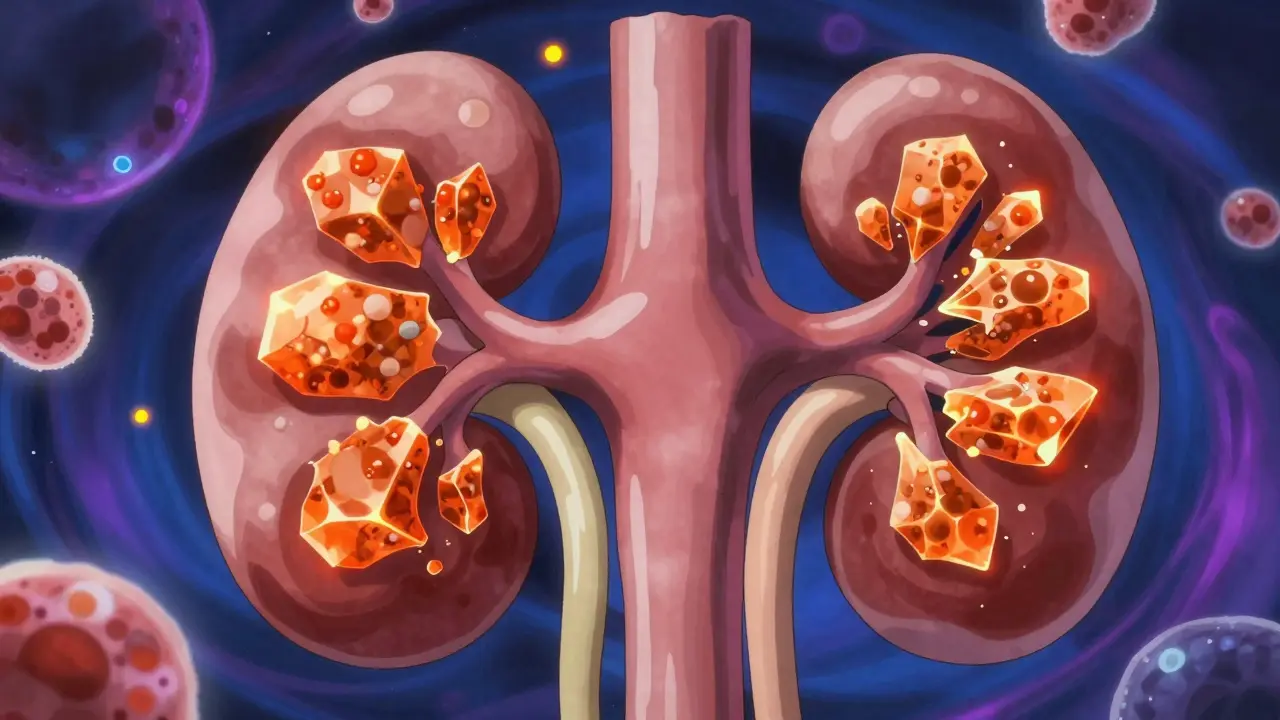

The Hidden Danger of Calcium Oxalate Stones
If you’ve ever been told you have kidney stones, a condition that affects 1 in 8 people, you know the pain is unlike anything else. But not all stones are created equal. The vast majority-about 70% to 80%-are calcium oxalate stones. These form when two common substances, calcium and oxalate, meet in your urine and crystallize. According to the National Kidney Foundation’s 2023 clinical guidelines, these stones are the most prevalent type, driven by urinary chemistry imbalances rather than just "eating too much calcium." In fact, the old advice to cut out dairy is often wrong and can make things worse. Understanding how these crystals form is the first step to stopping them from coming back. Without proper management, about 40% to 50% of people will face another episode within five years, a statistic highlighted in a 2022 meta-analysis in *European Urology*.
Hydration: The Single Most Effective Defense
You might think drinking water is obvious advice, but most people don’t drink enough to actually prevent stones. It’s not just about taking sips throughout the day; it’s about hitting specific volume targets. The National Institutes of Health (NIH) recommends aiming for 2.5 to 3.0 liters of total fluid intake daily. Why this amount? Because the goal isn’t just consumption-it’s output. You need to produce more than 2.5 liters of urine per day. A 2015 study in the *Clinical Journal of the American Society of Nephrology* found that producing 2.0 to 2.5 liters of urine daily cuts the risk of recurrence by half compared to producing less than 1.0 liter.
How do you know if you’re hitting the mark? Look at your urine color. It should be pale yellow or clear. If it’s dark yellow, you’re dehydrated. Water is the best choice, but you have options. Coffee and even beer have shown protective effects in studies, likely due to their diuretic properties and specific compounds. However, avoid grapefruit juice entirely. Research published in the *American Journal of Epidemiology* links grapefruit juice to increased stone risk. Instead, try adding lemon juice to your water. Dr. Eisner from Massachusetts General Hospital notes that half a cup of lemon juice concentrate diluted in water daily can increase urine citrate levels significantly. Citrate is a natural inhibitor of stone formation, binding to calcium so it doesn’t bind with oxalate.
Dietary Calcium: Eat More, Supplement Less
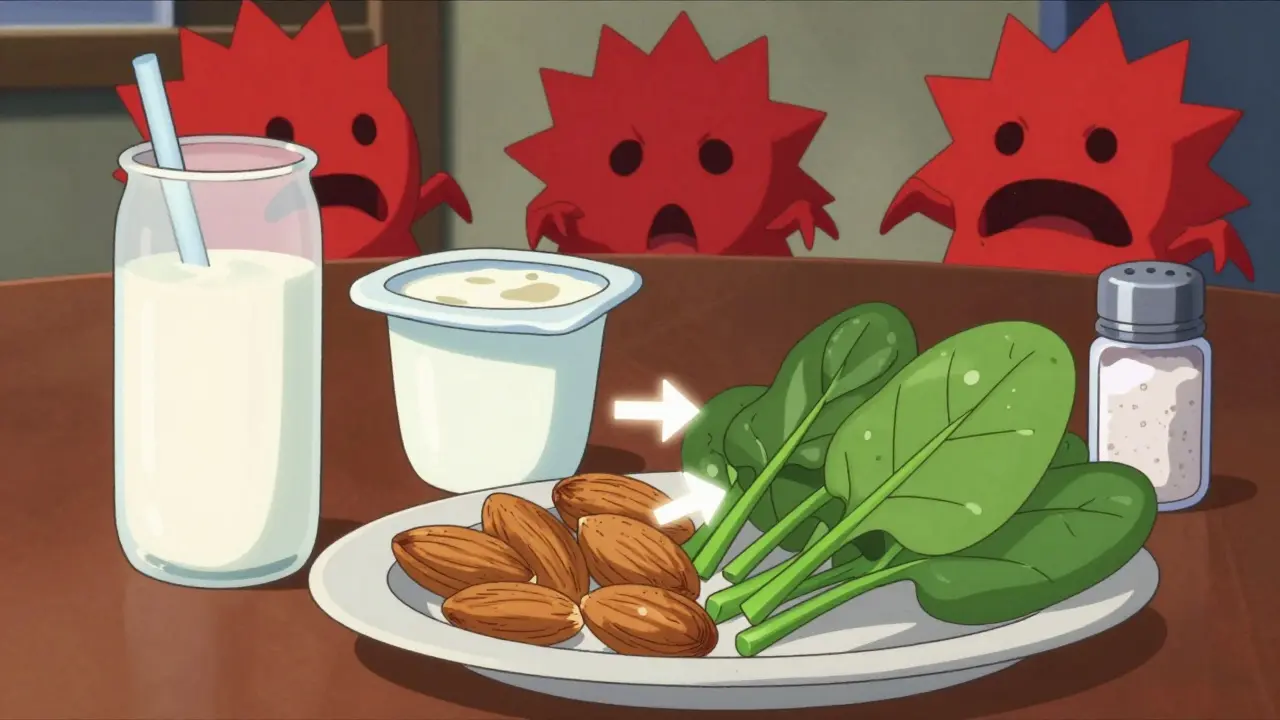
This is where most people get confused. For decades, patients were told to restrict calcium to stop calcium stones. Modern science says the opposite. You should consume 1,000 to 1,200 mg of calcium daily from food sources. Here’s why: when you eat calcium-rich foods alongside oxalate-rich foods, they bind together in your gut. This bound complex passes through your body in stool, never reaching your kidneys. If you restrict dietary calcium, more oxalate gets absorbed into your bloodstream, filtered by your kidneys, and ends up in your urine-where it forms stones.
Aim for 2-3 servings of dairy products daily. One serving is roughly 1 cup of milk, 1 ounce of cheese, or 3/4 cup of yogurt. The key is timing. Melanie Betz, MS, RD, CSR, FNKF, FAND, emphasizes in the National Kidney Foundation’s guidelines that calcium must be consumed simultaneously with oxalate-containing meals. Eating calcium two hours before or after an oxalate-rich meal reduces its binding efficacy by 40% to 50%. So, have your glass of milk with your spinach salad, not as a separate snack.
Be careful with supplements. Dr. Gary Curhan of Harvard Medical School warns that calcium supplements may increase stone risk by 20%, especially if taken without food. If you must supplement, choose calcium citrate over calcium carbonate, as recommended by the American Academy of Family Physicians. Calcium citrate is better absorbed and provides additional citrate, which helps prevent stones. Always take supplements with meals to maximize the gut-binding effect.

Sodium and Animal Protein: The Silent Contributors
Your salt intake directly impacts your stone risk. High sodium forces your kidneys to excrete more calcium into your urine. The American Heart Association recommends no more than 2,300 mg of sodium daily. Data from the Third National Health and Nutrition Examination Survey shows that every extra 1,000 mg of sodium correlates with a 25-30 mg increase in urinary calcium. Processed foods, canned soups, and fast food are the usual culprits. Read labels carefully; hidden sodium adds up quickly.
Animal protein also plays a role. Diets high in red meat, poultry, and eggs increase uric acid and lower urine pH, creating an acidic environment favorable for stone formation. Limit animal protein to less than 30% of your total caloric intake. For a standard 2,000-calorie diet, this means about 75 grams of protein daily. Replace some animal proteins with plant-based options like legumes, nuts, and seeds, but be mindful of their oxalate content.
Navigating High-Oxalate Foods
Oxalate is a natural compound found in many healthy foods. You don’t need to eliminate them, but you should manage them. High-oxalate foods include spinach (755 mg per 1/2 cup cooked), rhubarb (541 mg per 1/2 cup), almonds (122 mg per ounce), and navy beans (89 mg per 1/2 cup). The National Institute of Diabetes and Digestive and Kidney Diseases (NIDDK) advises against strict restriction unless you have a genetic mutation affecting oxalate transporters. Instead, balance these foods with calcium-rich items and plenty of fluids.
Vitamin C supplementation is another area of caution. Your body converts excess vitamin C into oxalate. Doses above 1,000 mg daily may increase stone risk, according to the NIH Office of Dietary Supplements. Stick to getting vitamin C from fruits and vegetables, which provide fiber and other nutrients that help mitigate risks. A 2020 meta-analysis in *Nutrients* found no significant association between dietary vitamin C and stone risk at doses below 500 mg daily.
| Fluid Type | Effect on Stone Risk | Key Mechanism | Recommendation |
|---|---|---|---|
| Water | Protective | Increases urine volume | Primary source; aim for 2.5-3L/day |
| Lemonade/Lemon Juice | Protective | Increases urine citrate | Add 1/2 cup concentrate daily |
| Coffee | Protective | Mild diuretic; unknown compounds | Moderate consumption acceptable |
| Grapefruit Juice | Risk Factor | Unknown mechanism; linked to higher risk | Avoid completely |
| Fizzy Drinks/Cola | Risk Factor | Phosphoric acid lowers citrate | Avoid or limit strictly |
Medical Interventions and Monitoring
If lifestyle changes aren’t enough, medication may be necessary. Thiazide diuretics, such as hydrochlorothiazide (12.5-50 mg daily), reduce urinary calcium excretion. They’ve shown a 30-50% reduction in stone recurrence in trials like the COMS study. However, they require monitoring for potassium levels and strict sodium restriction. Potassium citrate (10-20 mEq twice daily) is prescribed for hypocitraturia, a condition where urine citrate is low (<320 mg/24 hours). Allopurinol is used for hyperuricosuria (>550 mg/24 hours), reducing recurrence by 35% in patients with normal urinary calcium.
Monitoring is crucial. A 24-hour urine test establishes baseline chemistries. Targets include urine volume >2.5 L/day, calcium <250 mg/24 hours, oxalate <40 mg/24 hours, citrate >320 mg/24 hours, and sodium <200 mEq/24 hours. Adherence is challenging; only 35% of patients maintain adequate fluid intake at 12 months. Using mobile hydration tracking apps can improve adherence to 68%, according to a 2021 study in *Urology Practice*. Emerging research also looks at probiotics, specifically *Oxalobacter formigenes*, which showed a 30% reduction in urinary oxalate in early trials.
Practical Steps for Daily Prevention
Preventing calcium oxalate stones requires consistency. Start by setting a hydration reminder on your phone. Keep a water bottle visible at your desk. Plan meals that pair calcium with oxalate-like yogurt with berries or cheese with whole grains. Limit processed foods to control sodium. Avoid large doses of vitamin C supplements. If you have a history of stones, ask your doctor for a 24-hour urine test to personalize your strategy. Remember, prevention is a long-term commitment, but it drastically reduces pain, healthcare costs, and disruption to your life.
How much water should I drink to prevent kidney stones?
Aim for 2.5 to 3.0 liters of total fluid intake daily to produce more than 2.5 liters of urine. This volume significantly reduces the concentration of stone-forming minerals in your urine.
Should I avoid calcium if I have calcium oxalate stones?
No. You should consume 1,000 to 1,200 mg of calcium daily from food sources. Dietary calcium binds oxalate in the gut, preventing it from reaching the kidneys. Restricting calcium can actually increase stone risk.
What are the highest oxalate foods?
Spinach, rhubarb, almonds, and navy beans are very high in oxalate. Consume these with calcium-rich foods and plenty of water to minimize absorption.
Does lemon juice help prevent kidney stones?
Yes. Lemon juice increases urine citrate, which inhibits stone formation. Adding half a cup of lemon juice concentrate to water daily can boost citrate levels significantly.
Can coffee or beer help with kidney stones?
Studies suggest both coffee and beer have protective effects, possibly due to diuretic properties. However, water remains the primary recommendation for hydration.
Why is sodium bad for kidney stone patients?
High sodium intake increases urinary calcium excretion. Every 1,000 mg of extra sodium can add 25-30 mg of calcium to your urine, promoting crystal formation.
What medications are used for stone prevention?
Thiazide diuretics reduce urinary calcium, potassium citrate treats low citrate levels, and allopurinol manages high uric acid. Prescription depends on individual urine chemistry results.
Is vitamin C safe for kidney stone sufferers?
Dietary vitamin C is safe. However, supplements over 1,000 mg daily may increase oxalate production and stone risk. Stick to food sources or doses under 500 mg.
How does a 24-hour urine test help?
It identifies specific chemical imbalances like high calcium, low citrate, or high oxalate, allowing for personalized dietary and medical interventions.
Are calcium supplements risky?
Yes, if taken without food. They can increase stone risk by 20%. If needed, use calcium citrate with meals to enhance absorption and provide citrate.