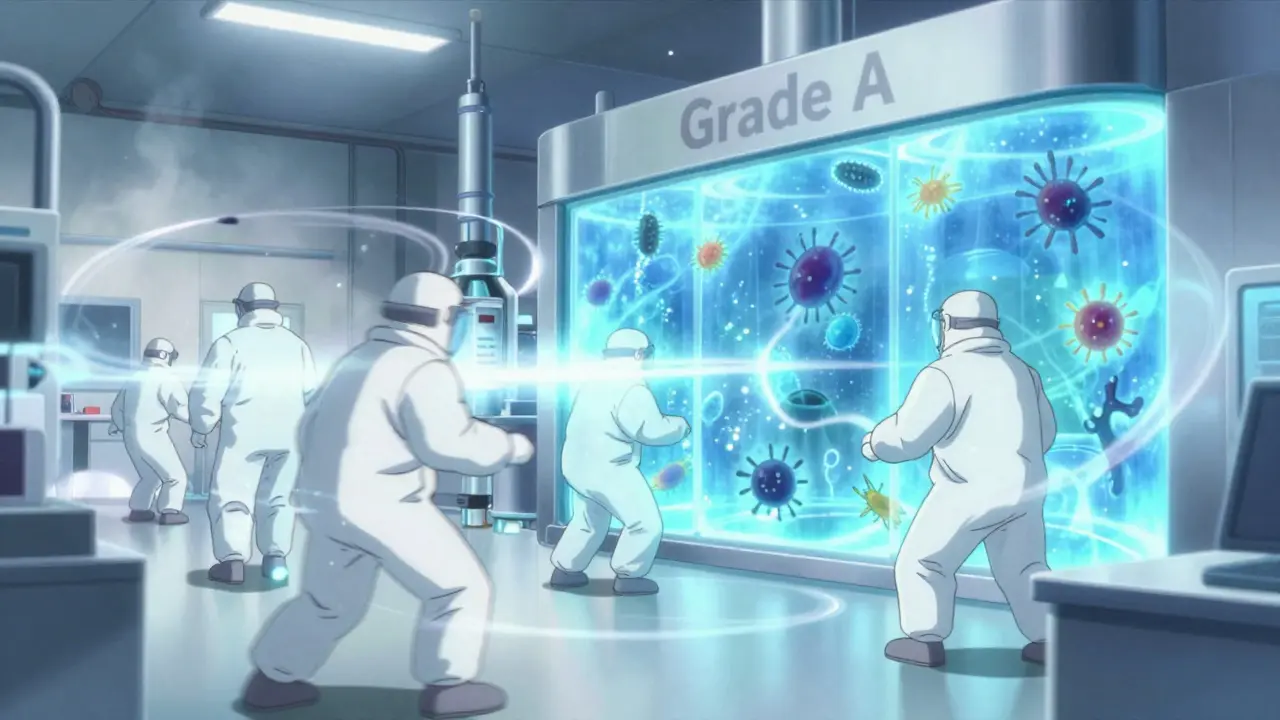

When you take a generic drug, you expect it to work just like the brand-name version. But behind that simple promise is a complex system of environmental controls-cleanroom standards-that keep the medicine safe, pure, and effective. These aren’t just guidelines. They’re legally enforced requirements that determine whether a generic drug can even reach pharmacy shelves. For manufacturers, meeting these standards isn’t optional-it’s the difference between staying in business and facing a multi-million-dollar recall.
What Cleanroom Standards Actually Do
Cleanroom standards exist to stop contamination before it happens. In pharmaceutical manufacturing, even tiny particles or microbes can ruin a batch of medicine. A speck of dust might carry bacteria. A human hair could introduce foreign material. In sterile injectables, that’s not just a quality issue-it’s a life-or-death risk. The system is built around four grades of cleanrooms, each with strict limits on airborne particles. Grade A is the cleanest, used for filling sterile products like IV bags or eye drops. It must have no more than 3,520 particles per cubic meter that are 0.5 micrometers or larger. That’s like having fewer than four grains of sand in a basketball. Grade B supports Grade A areas and has slightly higher limits. Grade C and D are for less critical steps like mixing powders or packaging pills. These aren’t arbitrary numbers. They come from ISO 14644-1, the global standard for cleanroom classification. The U.S. FDA and the European Union both use this system, though they describe it differently. The EU spells out exact ISO equivalents in Annex 1 of its GMP rules. The FDA doesn’t always name the ISO class-but if you’re making a generic injectable, you still have to meet the same particle limits as the original drug.Why Generic Drug Makers Face Unique Pressure
Generic drug companies don’t get to pick their standards. They have to match the innovator drug exactly. If the brand-name version was made in a Grade A cleanroom, so must the generic. There’s no shortcut. The FDA’s Orange Book requires bioequivalence-not just chemical similarity, but identical performance in the body. That means the manufacturing environment must be just as controlled. This creates a financial squeeze. Brand-name companies often charge $100 or more per dose. Generic makers sell the same drug for $0.50. Their profit margins? Around 15-20%. Meanwhile, upgrading a cleanroom to Grade A can cost $250-$500 per square foot. One generic manufacturer told ISPE they spent $2.3 million just to upgrade HVAC systems for a single oncology product. That’s a huge bet on a drug that might only earn pennies per unit. And it’s not just about hardware. Personnel training is critical. Gowning up in a cleanroom takes 40-60 hours of training. One wrong move-touching your face, walking too fast, not sealing a glove properly-can spike particle counts. In 2022, 42% of FDA complete response letters for sterile generics cited environmental monitoring failures. That’s up from 31% in 2018. Regulators are watching closer than ever.What Happens When Standards Fail
The consequences of falling short aren’t theoretical. In 2012, the New England Compounding Center’s poor cleanroom practices led to a fungal meningitis outbreak that killed 64 people and sickened over 750. It wasn’t a big company-it was a compounding pharmacy. But the lesson was clear: contamination kills. More recently, Aurobindo Pharma paid $137 million to recall sterile injectables in 2022 after FDA inspections found inadequate Grade B monitoring. The company had been shipping products with unapproved particle levels. The FDA issued a consent decree, halting production until the issues were fixed. That’s not just a financial hit-it’s a loss of trust. Hospitals won’t buy from a supplier with a history of contamination. Even smaller failures matter. A single batch of a generic antibiotic that doesn’t meet particle limits might not cause immediate harm. But if it’s inconsistent, doctors can’t trust the drug. And if patients start having unexpected reactions, the whole generic category suffers.
Costs vs. Benefits: Is It Worth It?
Some experts question whether every cleanroom grade is necessary. Dr. Paul K. S. Shin, a leading voice in pharmaceutical science, argued in 2021 that Grade C requirements for oral solid tablets are excessive. He pointed to a study showing identical dissolution rates between tablets made in Grade D and Grade C rooms. Why spend millions on air filters for pills you swallow? But for sterile products-injectables, inhalers, eye drops-the answer is clear. You can’t afford to cut corners. The FDA’s 2023 Strategic Plan predicts that by 2025, half of all new generic applications will require Grade A or B environments. That’s up from 35% in 2022. Why? Because more generics are now complex biologics, biosimilars, and inhalation products. These aren’t simple pills. They’re delicate, sensitive, and easily contaminated. The upside? Companies that get it right see real benefits. Teva’s generic version of Copaxone, a multiple sclerosis drug, had its first FDA approval after installing advanced isolator systems in Grade A areas. Contamination events dropped from 12 per year to just 2. That’s not just compliance-it’s reliability. And reliability builds long-term contracts with hospitals and insurers.How Cleanrooms Are Evolving
The rules are changing. The EU’s Annex 1 update in August 2023 requires continuous air monitoring-not just spot checks. It demands a full contamination control strategy, not just a checklist. The FDA is expected to follow suit. That means sensors in the ceiling, real-time alerts, and automated logs. No more manual plates sitting out overnight. New tech is helping. Robotics are reducing human error. AI-powered systems can predict contamination risks before they happen. One manufacturer reported a 30% drop in deviations after installing smart monitoring. The cost? $50,000-$100,000 per room. But compared to a $100 million recall, it’s a bargain. Humidity and temperature matter too. In tropical climates like India or Southeast Asia, keeping humidity between 30-60% can add 20-30% to HVAC costs. Many generic manufacturers there spent an average of $4.2 million per facility to meet Annex 1 standards-nearly $1.4 million more than U.S. counterparts. Infrastructure gaps make compliance harder, but not optional.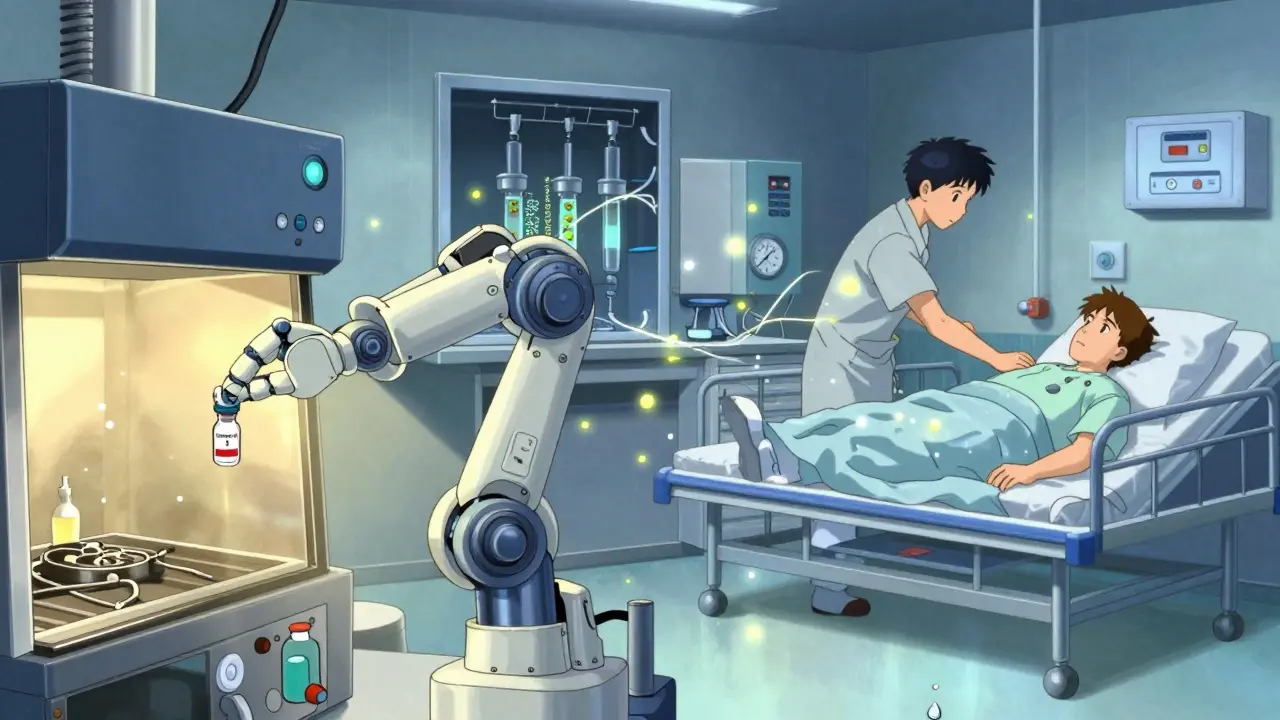
What Manufacturers Need to Do
If you’re running a generic drug facility, here’s what you need to focus on:- Know your grade. Are you making sterile injectables? You need Grade A/B. Oral tablets? Grade C might be enough-but check the reference product’s original environment.
- Train your people. Gowning isn’t a formality. It’s a science. Train staff for 60 hours minimum. Test them. Re-train quarterly.
- Monitor continuously. Don’t wait for FDA inspections to find problems. Install real-time particle and microbial sensors. Set alerts for spikes.
- Document everything. You need 15-20 SOPs covering everything from cleaning schedules to equipment calibration. The FDA doesn’t just look at results-they look at your process.
- Plan for upgrades. Cleanrooms aren’t one-time investments. HVAC filters degrade. Sensors drift. Budget for annual maintenance. Expect to spend 15-25% of your capital budget on cleanroom upkeep.
Resources That Actually Help
You don’t have to figure this out alone. The FDA offers free online training modules on cGMP. ISPE publishes practical guides on HVAC design and contamination control. The Parenteral Drug Association has Technical Reports numbered 14, 22, and 45-detailed manuals used by inspectors and manufacturers alike. The bottom line? Cleanroom standards aren’t about perfection. They’re about control. You can’t eliminate every risk. But you can build systems that catch problems before they reach patients. For generic drug makers, that’s the only way to compete-not on price alone, but on trust.What are the four grades of cleanrooms in pharmaceutical manufacturing?
The four grades are A, B, C, and D, based on particle and microbial limits. Grade A (ISO Class 5) is for sterile filling operations, allowing no more than 3,520 particles ≥0.5μm per cubic meter. Grade B (ISO Class 5 at rest, ISO Class 7 operational) supports Grade A areas. Grade C (ISO Class 7 at rest, ISO Class 8 operational) is used for less critical processes like mixing. Grade D (ISO Class 8 at rest) is for final packaging and other low-risk steps. Each grade has specific air change rates, pressure differentials, and monitoring requirements.
Why are cleanroom standards stricter for generic drugs than for some other products?
They’re not necessarily stricter-they’re the same. Generic manufacturers must match the exact environment used to make the original brand-name drug. If the innovator product was made in a Grade A cleanroom, the generic must be too. The FDA requires bioequivalence, meaning the drug must perform identically in the body. That includes matching the manufacturing conditions that affect stability, purity, and potency. Generic makers don’t get to simplify the process just because they’re cheaper.
How much does it cost to build a compliant cleanroom for generic drugs?
Costs vary widely. A Grade A cleanroom can cost $250-$500 per square foot to build. For a 2,000-square-foot facility, that’s $500,000 to $1 million. Additional costs include continuous monitoring systems ($50,000-$100,000), HVAC upgrades, and validation testing ($150,000-$500,000). For small manufacturers, total compliance costs can reach $2-5 million. These expenses make up 15-25% of total facility capital spending for generic companies, compared to 10-15% for brand-name firms.
What happens if a generic drug manufacturer fails a cleanroom inspection?
Failure can lead to an FDA Form 483 (observation list), a warning letter, or even an import alert blocking shipments. In severe cases, the FDA issues a consent decree, halting all production until corrections are made. Aurobindo Pharma faced a $137 million recall and a consent decree in 2022 after failing Grade B monitoring. Products already on the market may be recalled. The company loses revenue, market share, and credibility. For small manufacturers, one major failure can be fatal.
Are cleanroom standards the same worldwide?
Most major markets-U.S., EU, Japan, Canada, Australia-follow harmonized standards based on ISO 14644 and ICH Q7. The EU’s Annex 1 is the most detailed, explicitly linking grades to ISO classes. The FDA doesn’t always name the ISO class but enforces the same particle limits. Japan requires additional monitoring at 1.0μm particle size. While rules are similar, enforcement and inspection frequency vary. Generic manufacturers exporting globally must comply with the strictest standard their product is sold in.
Can cleanroom standards be reduced for non-sterile generic drugs?
Possibly, but only if the reference product was made under similar conditions. For oral solids like tablets or capsules, Grade C or even Grade D may be acceptable if supported by data. However, the FDA still expects contamination control. A 2020 study showed identical dissolution profiles from Grade D and Grade C rooms for some oral drugs, suggesting some standards may be overly conservative. But regulators still require justification. You can’t assume lower standards-you must prove they’re safe.
How often do cleanrooms need to be revalidated?
Initial validation takes 3-6 months and must be done before production starts. After that, revalidation is required annually, or after major changes like equipment upgrades, facility renovations, or changes in product type. Continuous monitoring systems reduce the need for frequent manual tests, but formal revalidation is still mandatory. The FDA expects evidence that the cleanroom remains in control over time-not just on the day of inspection.


