
When you buy medicine, food, or cosmetics, you expect it to be safe. But behind every product is a hidden battle against invisible threats: bacteria, mold, metal particles, and chemical residues. Environmental monitoring is how manufacturers stop these threats before they reach you. It’s not just a checklist-it’s the backbone of quality control in regulated industries.
Why Environmental Monitoring Matters
Think of your factory floor like a hospital ward. Even a single microbe landing on a surface can contaminate thousands of units. In 2022, the USDA estimated foodborne illnesses tied to poor environmental control cost the U.S. economy $77.7 billion. That’s not just lost sales-it’s hospital visits, recalls, and broken trust. The FDA and European Medicines Agency (EMA) don’t treat this as optional. Their guidelines make it clear: if you’re making pharmaceuticals, ready-to-eat food, or sterile cosmetics, you must monitor your environment. It’s not about catching contamination after it happens. It’s about proving you’re stopping it before it starts. A 2023 FDA report confirmed that facilities using consistent environmental monitoring saw 32% faster production turnarounds. Why? Because ATP testing-quick surface swabs that detect organic residue-gives results in seconds. Traditional lab tests take days. Waiting means downtime. Monitoring keeps lines running and products safe.How Contamination Gets In: The Four Zones
Every facility uses a zone system to prioritize where to look. It’s simple: risk decreases the farther you get from direct product contact.- Zone 1: Surfaces that touch the product directly-mixers, conveyors, slicers, packaging nozzles. This is ground zero. If Listeria or Salmonella lands here, your whole batch is at risk.
- Zone 2: Nearby surfaces that don’t touch the product but could spread contamination-equipment housings, refrigeration units, nearby walls. Condensation dripping from a pipe above a filler? That’s a Zone 2 hazard.
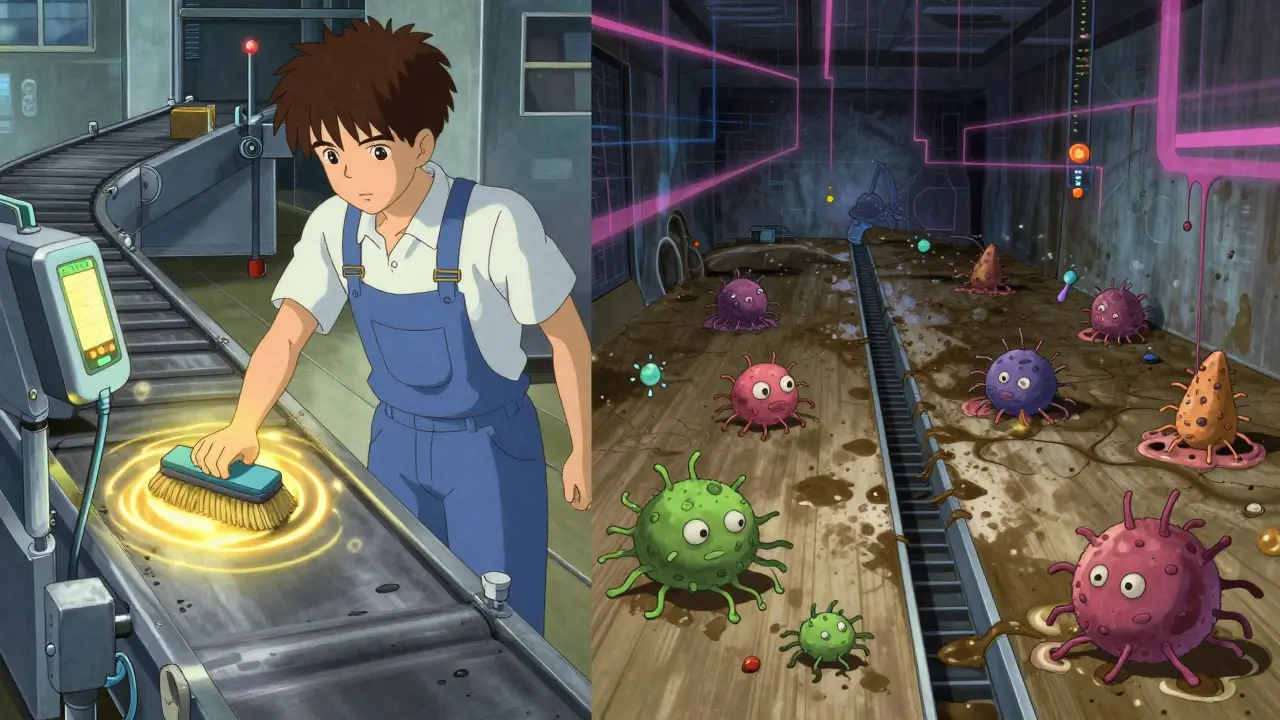
- Zone 3: Areas near production but not directly involved-forklifts, carts, storage racks, floor drains. Surprising fact: a 2013 PPD Laboratories study found floors were the source of 62% of all contamination alerts. Dirty floors spread microbes like a trail.
- Zone 4: Remote areas-break rooms, offices, entryways. These are low risk, but they’re entry points. A worker’s shoe tracking in dirt from outside? That’s how it starts.
What They Test For: Microbes, Particles, Chemicals
Not all contamination looks the same. Different tools catch different threats.- Microbiological testing: Swabs and air samplers detect bacteria like Listeria monocytogenes, Salmonella, and mold. These are the big killers in food and pharma. The FDA specifically targets these in inspections.
- Air sampling: Liquid impingers and solid impactors pull air through devices to catch airborne particles and spores. Results are measured in colony-forming units per cubic meter (CFU/m³). Cleanrooms in pharmaceutical plants must stay below ISO Class 5 standards-think hospital operating rooms.
- ATP testing: Measures adenosine triphosphate, a molecule found in all living cells. High ATP = poor cleaning. It’s fast, cheap, and used to verify sanitation between shifts.
- Water testing: Pharmaceutical plants test purified water for total organic carbon (TOC) and conductivity, following USP <645> standards. Food plants check municipal water for EPA compliance.
- Chemical and metal detection: Inductively Coupled Plasma (ICP) detects trace metals like lead or mercury. Chromatography (GC, HPLC) finds chemical residues from cleaning agents or lubricants.
Regulations That Shape the Process
Different industries follow different rules-but they’re all tightening.- Pharmaceuticals: EU GMP Annex 1 (updated August 2023) demands real-time monitoring of air quality, temperature, and humidity in cleanrooms. Continuous data logging is now required. No more manual logs.
- Food processing: USDA’s Listeria Rule (9 CFR Part 430) forces RTE food plants to test Zone 1 surfaces weekly for Listeria. The FDA’s Food Safety Modernization Act (FSMA) made environmental monitoring mandatory for all registered facilities.
- Cosmetics: While less regulated than pharma, facilities exporting to the EU must follow similar standards under Annex 1. The FDA can shut down a facility for repeated environmental failures-even without a recalled product.
Common Mistakes and How to Avoid Them
Even well-intentioned facilities fail-not because they don’t care, but because they cut corners.- Inconsistent sampling: 68% of facilities report staff using different techniques-swabbing too hard, missing corners, not sterilizing samplers. Training matters. The FDA recommends 40 hours of hands-on practice before anyone touches a swab.
- Poor zone classification: 42% of facilities can’t agree on what counts as Zone 1. Create a documented risk map. Include photos, flow diagrams, and input from line workers.
- Data silos: ATP results, microbial cultures, and allergen tests often sit in separate spreadsheets. Integration is key. Modern systems pull all data into one dashboard, flagging trends before they become problems.
- Ignoring Zone 3 and 4: Floors, drains, and carts are overlooked. But as PPD Labs found, 62% of contamination events started there. Clean them like you clean Zone 1.
What a Successful Program Looks Like
A strong environmental monitoring program isn’t about doing more tests. It’s about doing the right tests, the right way, at the right time.- Zone-based sampling with clear, documented criteria
- Regular training with competency checks
- Real-time ATP testing to verify cleaning
- Microbial results tracked over time-not just pass/fail
- Integration of all data into one system for trend analysis
- Management reviews every quarter to adjust risk levels
Final Thought: It’s Not About Compliance. It’s About Control.
Environmental monitoring isn’t a cost center. It’s a control system. Like brakes in a car, you don’t notice it until you need it. But when you do-when a batch is saved, a recall avoided, a customer protected-that’s when you see its true value. The data doesn’t lie: facilities with strong programs have fewer incidents, faster turnarounds, and better audit scores. The ones that treat it as a chore? They’re the ones getting shut down.What is the main purpose of environmental monitoring in manufacturing?
The main purpose is to detect and prevent contamination from microbes, particles, and chemicals before they affect products. It’s a proactive system that verifies cleaning procedures, identifies contamination sources, and ensures products meet safety standards-protecting consumers and avoiding costly recalls.
How often should environmental samples be collected?
Frequency depends on the zone and risk level. Zone 1 (direct product contact) is sampled daily to weekly. Zone 2 (near contact) is tested weekly to monthly. Zone 3 and 4 (remote areas) are sampled monthly to quarterly. High-risk products like ready-to-eat foods may require daily Zone 1 testing for pathogens like Listeria.
What’s the difference between ATP testing and microbiological testing?
ATP testing detects organic residue from any living cell and gives results in seconds-it’s used to check if a surface was cleaned properly. Microbiological testing identifies specific microbes like bacteria or mold, but takes 24-72 hours in a lab. ATP is for quick verification; microbiological testing confirms actual contamination.
Why are Zone 3 and Zone 4 surfaces important to monitor?
Even though they don’t touch products, Zone 3 and 4 surfaces-like floors, carts, and drains-are where contamination often starts. A 2013 study found floors caused 62% of contamination events. Dirt, water, and people move microbes from these areas into higher-risk zones. Ignoring them creates blind spots.
Which industries require the strictest environmental monitoring?
Pharmaceutical manufacturing has the strictest requirements, especially under EU GMP Annex 1, which mandates real-time air and environmental monitoring in cleanrooms. Ready-to-eat food facilities follow closely, with mandatory weekly Listeria testing. Cosmetics are less regulated but still face strict standards when exporting to the EU or U.S.
Can environmental monitoring prevent product recalls?
Yes. The CDC estimates 87% of foodborne outbreaks linked to environmental contamination could have been prevented with proper monitoring. By catching pathogens like Listeria or Salmonella on surfaces before they contaminate products, companies avoid recalls, legal penalties, and brand damage.
What are the biggest challenges in implementing environmental monitoring?
The top challenges are inconsistent sampling techniques (68% of facilities), unclear zone classification (42%), and poor integration of data from ATP, microbiological, and allergen tests (37%). Training staff properly and using digital systems to centralize data are the most effective fixes.


