Green Tea & Warfarin Risk Estimator
Use this tool to understand how your tea habits might affect your blood clotting levels. Disclaimer: This is an educational tool, not medical advice. Always consult your doctor for INR adjustments.
Cups/Day
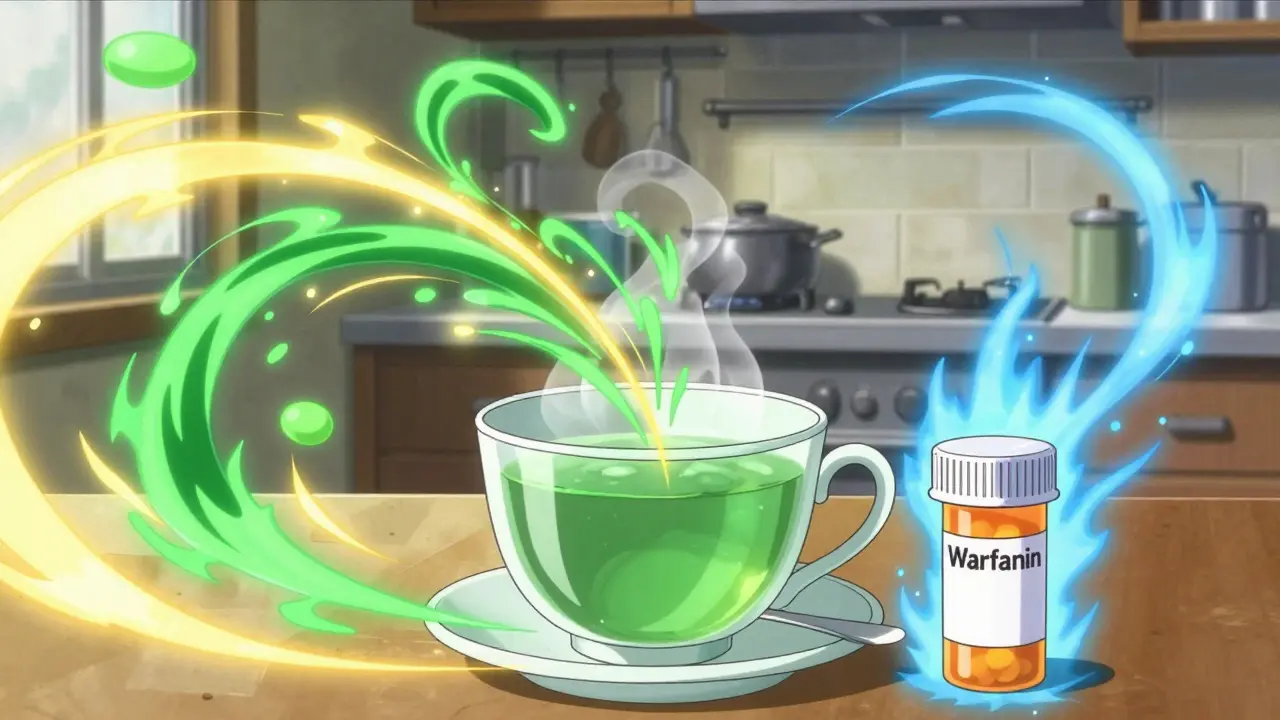

Use this tool to understand how your tea habits might affect your blood clotting levels. Disclaimer: This is an educational tool, not medical advice. Always consult your doctor for INR adjustments.
The real issue here isn't just the tea itself, but the Vitamin K it contains. Warfarin works by blocking the body's ability to use vitamin K to make clotting factors. When you flood your system with extra vitamin K from green tea, you're essentially giving your body a way to bypass the medication. This leads to a drop in your International Normalized Ratio (INR), which is the standard measurement doctors use to see how quickly your blood clots. If your INR drops too low, your blood becomes "too thick," and the risk of clotting goes up.
You don't need to throw away your tea bags just yet. The impact on your blood clotting depends almost entirely on how much you drink and how you prepare it. Most medical experts, including those at the American Heart Association, agree that drinking 1 to 3 cups of brewed green tea a day is generally safe for most people and doesn't require a change in medication dose.
The danger zone starts when consumption becomes excessive. There are documented cases where people drinking over a gallon of green tea daily saw their INR plummet-in one instance, a man's INR dropped from 3.79 to 1.37. This is a massive shift that would likely require an immediate increase in medication to prevent a medical emergency. However, the type of green tea you choose matters even more than the volume.
| Tea Type | Vitamin K Level | Impact on INR | Risk Level |
|---|---|---|---|
| Brewed Green Tea | Very Low (~0.03 μg/100g) | Minimal (at 1-3 cups/day) | Low |
| Matcha Powder | High (Entire leaf consumed) | Significant drop possible | Moderate to High |
| Dried Tea Leaves | Very High (1,428 μg/100g) | Potentially severe | High |
If you love Matcha, you need to be extra careful. Unlike regular green tea where you steep the leaves and then toss them, matcha involves drinking the actual ground-up leaf. This means you're consuming 10 to 20 times more vitamin K than you would with a standard cup of tea. Some patients have reported their INR dropping significantly after just two weeks of drinking matcha daily, requiring a dose increase of about 15% to get back into the safe zone.
Even the way you brew your tea can change the outcome. Research suggests that hot-brewing extracts more vitamin K than cold-brewing. While this might seem like a small detail, for someone on a narrow therapeutic range of Warfarin, these small variables add up. The goal isn't to avoid vitamin K entirely-your body actually needs it for normal function-but to keep your intake consistent. If you drink two cups every morning, keep doing that. The problem arises when you go from zero cups to five cups in one weekend.
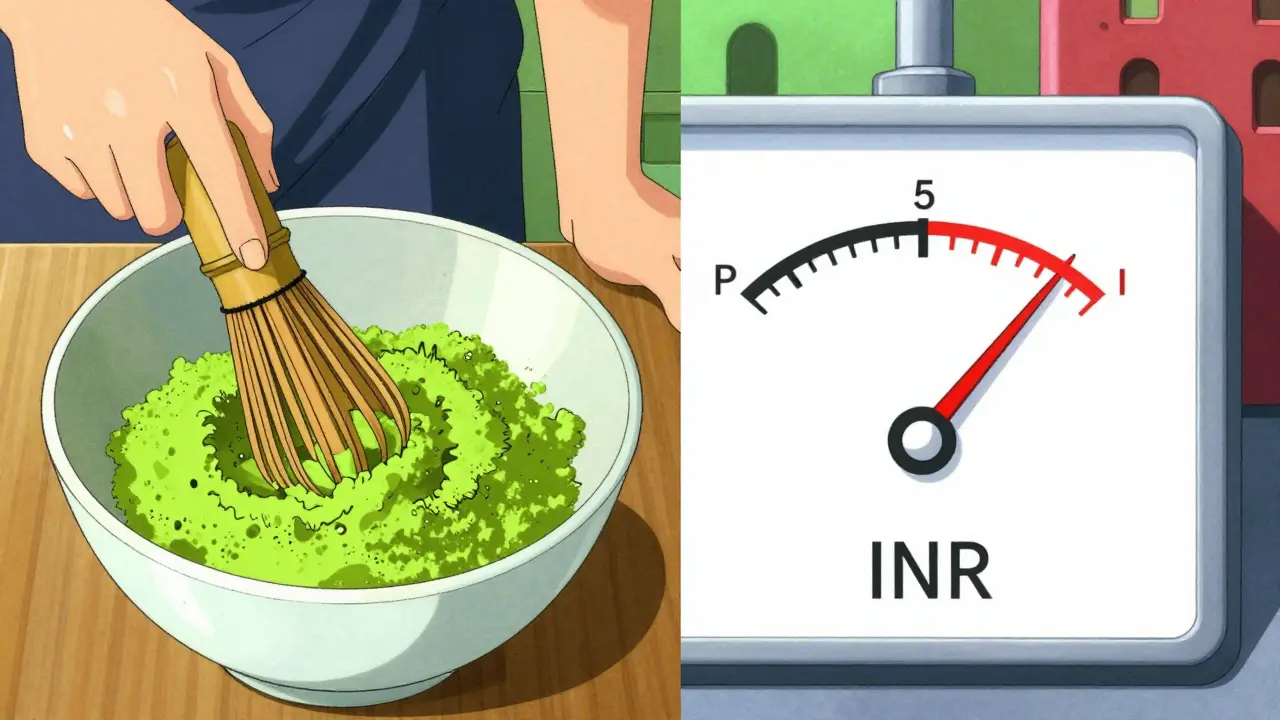
It's easy to get confused about which foods to avoid. You've probably heard that spinach and kale are the "big enemies" of Warfarin. While that's true, they are much more concentrated sources of vitamin K than a cup of brewed tea. For example, raw spinach has nearly 5,000 times more vitamin K per 100g than brewed green tea does. You would have to drink a staggering amount of tea to match the impact of a large bowl of spinach.
However, green tea is different from things like cranberry juice. Cranberry juice doesn't usually affect vitamin K; instead, it can interfere with how your liver processes Warfarin, which often *increases* your INR and makes you bleed more easily. Green tea generally does the opposite by *decreasing* your INR and making you more prone to clots. This creates a confusing landscape for patients who are told to "be careful" with all herbal products without being told *why* the effect is different for each one.

Managing your health doesn't have to mean giving up everything you enjoy. The key is a strategy of consistency and communication. If you are a regular tea drinker, your doctor can adjust your Warfarin dose to account for your tea intake. The risk only becomes critical when your habits change suddenly.
One critical warning: if you have been drinking large amounts of green tea and suddenly stop, your INR could spike dangerously high. In one case, a woman's INR jumped from 1.7 to 5.0 within a week of stopping her tea habit because her body was suddenly no longer fighting the medication. Always taper off or notify your healthcare provider before making a drastic change in your diet.
Yes, most people can safely enjoy 1 to 3 cups of brewed green tea per day. The key is consistency. As long as you drink roughly the same amount every day, your doctor can calibrate your dose to keep your INR stable.
Matcha is made from powdered whole leaves, meaning you consume the entire leaf rather than just the infused water. This results in a much higher concentration of vitamin K, which can more aggressively lower your INR and make Warfarin less effective.
A low INR means your blood is clotting more quickly than it should. This increases the risk of developing a blood clot, which could lead to a stroke or a pulmonary embolism. You should contact your doctor immediately if you suspect your INR has dropped.
Generally, yes. Some evidence suggests that cold-brewing extracts less vitamin K from the leaves than hot-brewing, though the difference is small for those drinking in moderation.
No. Your body needs vitamin K for normal blood clotting and bone health. The goal of Warfarin therapy is not total avoidance, but stable, consistent intake so the medication can work predictably.
If you're currently on Warfarin and love your tea, your first step should be an honest conversation with your pharmacist or doctor about exactly how much you drink. Don't just say "a little bit"; tell them if it's two cups of brewed tea or three tablespoons of matcha powder.
If you notice unusual bruising or, conversely, signs of a clot (like swelling in one leg or sudden shortness of breath), get your INR checked immediately. For those who struggle to keep a consistent diet, using a health tracking app to log daily tea consumption can be a lifesaver, providing a clear data trail that helps your doctor make precise dose adjustments.

April 16, 2026 AT 22:44
Omg I literally cannot even deal with the stress of this right now because I just started a green tea detox last week and now I'm sitting here shaking thinking about my blood clotting in some horrifying way and honestly my anxiety is just through the roof 😱😭 it is just so unfair that we have to walk on eggshells with our own bodies and I feel like I'm just spiraling into a void of medical terror and no one even understands how exhausting it is to constantly monitor every single sip of liquid just to stay alive 💔🥀✨

April 17, 2026 AT 09:32
The fundamental failure here is the lack of individual responsibility and the pathetic reliance on a 'doctor' to calibrate a lifestyle. If a man cannot maintain the basic discipline of a consistent diet, he has essentially surrendered his sovereignty to the state of sickness. We treat our health like a buffet of convenience and then act shocked when the biological consequences manifest. It is a moral imperative to master one's own biology rather than whining about the 'difficulty' of not drinking a gallon of tea. True wellness is forged in the fire of restriction and discipline, not in the lukewarm comfort of 'moderate' guidelines provided by a bureaucracy.

April 18, 2026 AT 13:57
Oh my goodness, what a wonderfully enlightening piece of information that truly empowers us to take charge of our wellness journey with such grace and precision! I am absolutely thrilled to see such detailed guidance because it is simply marvelous how a little bit of knowledge can transform a scary situation into a manageable and even beautiful routine of self-care. We must all remember that our bodies are magnificent temples and by simply being mindful of our habits, we can soar toward a healthier future with an abundance of joy and a heart full of hope! 🌸🌟

April 18, 2026 AT 23:34
I'm literally Gasping! I knew someone who tried this and their whole life just fell apart because they ignored the matcha warning and ended up in the ER in a complete state of chaos! It's just so wild how one little powder can basically rewrite your blood chemistry in two weeks!

April 19, 2026 AT 19:05
The way the liver processes cranberry juice versus how the gut handles the vitamin K in matcha is such a kaleidoscopic mess of biochemistry... it's kind of wild how one thing makes you a bleeder and the other makes you a clotted mess (⊙_⊙) purely based on the molecular path they take.

April 20, 2026 AT 22:06
USA is the only place where u gotta worry about tea cuz our healthcare is so messy lol!! 🇺🇸💪 just follow the rules and stay strong baby!

April 21, 2026 AT 02:41
Typical American medical nonsense trying to tell us how to live, but at least we have the freedom to choose our tea unlike those other countries with their socialist nightmares! I'll drink as much matcha as I want and let the US medical system handle the fallout because that's what my taxes are for!