
Every time you pick up a prescription, you’re holding your safety in your hands. It’s not just about getting the right medicine-it’s about making sure the medication strength and quantity match what your doctor ordered. A single mistake-like confusing 0.25 mg with 25 mg-can land you in the hospital. And it happens more often than you think. Around 1.3 million medication errors occur in the U.S. every year, and nearly a quarter of them involve wrong strength or dosage. The good news? You don’t need to be a pharmacist to catch these errors. You just need to know where to look and what to check.
Where to Find Medication Strength on the Label
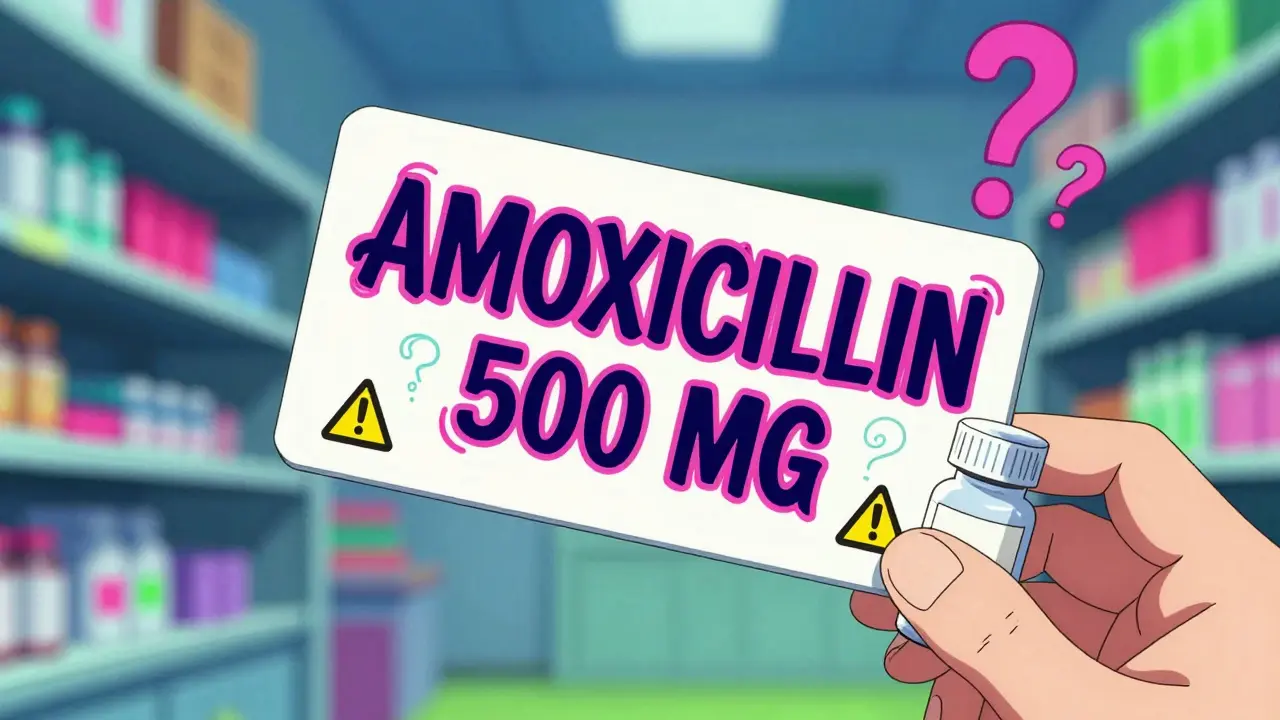
The strength of your medication is the amount of active ingredient in each dose. It’s usually printed right next to the drug name. For tablets and capsules, you’ll see something like AMOXICILLIN 500 MG. That means each pill contains 500 milligrams of amoxicillin. For liquids, it’s different. You’ll see a ratio, like 250 MG/5 ML. That means every 5 milliliters of liquid contains 250 milligrams of the drug. Creams and ointments often show percentage strength, like HYDROCORTISONE 1%, meaning 1 gram of the cream has 10 milligrams of hydrocortisone.
Pharmacies don’t always put it in the exact same spot. CVS usually lists strength directly under the drug name. Walgreens often puts it in parentheses right after the name. Kaiser Permanente sometimes adds a small box labeled “Strength Verification” with a QR code you can scan for more info. No matter where it is, the strength should be clearly visible and not buried in small print. If you can’t find it quickly, ask the pharmacist to point it out. They’re used to it.
Understanding Quantity: What the Number Really Means
Quantity tells you how much total medicine you’re getting. It’s not the same as your daily dose. For example, if your label says 30 TABLETS, that’s the total number of pills in the bottle-not how many you take each day. If your doctor told you to take one pill twice a day, that 30-tablet bottle will last you 15 days. If you see 120 mL, that’s the total volume of liquid in the bottle. For creams, it might say 30 GRAMS. Always check the unit. Mixing up milliliters (mL) with milligrams (mg) is a common mistake-and dangerous.
Some people assume the quantity is their daily dose. That’s where confusion starts. A label might say 5 MG/5 ML and 120 ML. The 5 mg is the dose per 5 mL. The 120 mL is how much you have in total. If you take 5 mL once a day, you’ll have 24 days’ worth. If you accidentally think the 5 mg is your total dose, you might take way too much. Always read both parts: the concentration and the total amount.
Why Units Matter More Than You Think
Units can make or break your safety. A tiny mistake with units can lead to a 1,000-fold overdose. For example, 0.5 mg and 500 mcg are the same thing-but if you misread “mcg” as “mg,” you’re taking 1,000 times too much. That’s why pharmacies are required to spell out units fully: micrograms, not mcg; milligrams, not mg; units, not U. The letter “U” can look like a zero, and “mcg” can be mistaken for “mg” if the print is small. That’s why the FDA and pharmacy boards now require full words on labels.
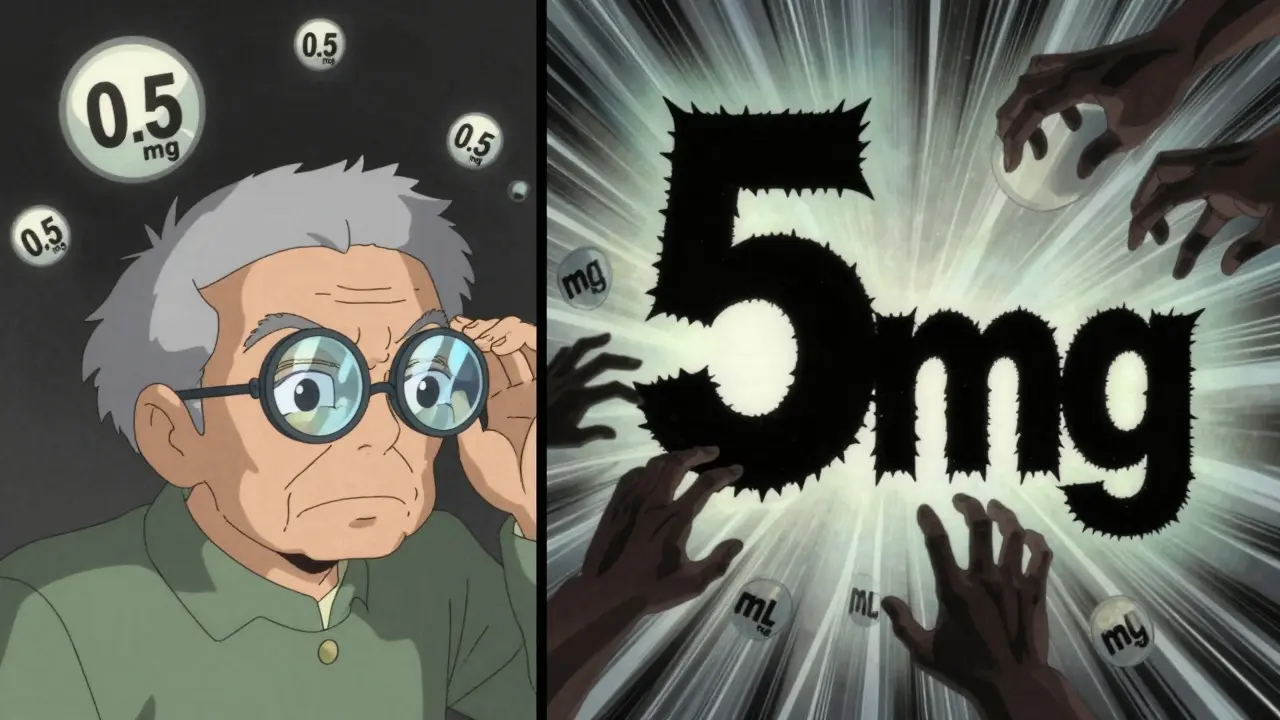
Another common trap is decimal points. 0.5 mg looks like 5 mg if the zero is faded or the font is small. That’s why the Institute for Safe Medication Practices says 18.7% of fatal pediatric errors come from decimal misreads. Always look closely at numbers with decimals. If you’re unsure, hold the label up to the light or use your phone’s magnifier app. Don’t guess.
How to Verify Your Prescription: A Simple 4-Step Check
Before you leave the pharmacy, do this quick check:
- Find the drug name-make sure it’s the one your doctor prescribed. Generic names (like “amoxicillin”) are required, but brand names (like “Amoxil”) might appear too.
- Locate the strength-is it written clearly? Does it match what your doctor told you? If your prescription said “500 mg,” and the label says “250 mg,” stop. Ask why.
- Check the quantity-is the total amount right? If you were supposed to get a 30-day supply and you got 60 pills, ask if it’s intentional. Sometimes pharmacies overfill, but it’s worth confirming.
- Compare with your prescription-do you have a copy from your doctor? Look at the dose, frequency, and duration. If the label doesn’t match, don’t take it. Call your doctor’s office or go back to the pharmacy.
This process takes less than a minute. But it’s saved thousands of people from taking the wrong dose. One Reddit user, u/MedSafetyMom, caught her son’s amoxicillin dose being doubled because the pharmacy filled it as 500 mg/5 mL instead of 250 mg/5 mL. She didn’t know the difference until she checked. That’s the kind of mistake you can prevent.
Common Mistakes and How to Avoid Them
Here are the top errors people make-and how to dodge them:
- Misreading decimals: 0.25 mg looks like 25 mg. Always zoom in or use a magnifying app.
- Confusing total quantity with daily dose: 30 tablets ≠ 30 mg. One is how many pills; the other is how strong each pill is.
- Ignoring units: mcg vs. mg, mL vs. mg. If you’re unsure, ask the pharmacist to explain it in plain language.
- Assuming the label is always right: Pharmacies are busy. Even with AI systems, mistakes happen. You’re the last line of defense.
People over 65 are most at risk. Nearly 38% of strength-related errors happen in older adults. That’s often because of vision issues or taking multiple meds. If you’re in that group, ask for a large-print label. Most chain pharmacies offer it for free. You can also ask for a high-contrast label-black text on white background, no fancy fonts.
What to Do If Something Looks Wrong
If the label doesn’t match your prescription, don’t take the medicine. Don’t assume it’s a typo. Don’t wait until later. Go back to the pharmacy immediately. Bring your prescription slip or a photo of it. Ask to speak with the pharmacist-not just the technician. Pharmacists are trained to catch these errors. If they dismiss your concern, call your doctor’s office. You have the right to be safe.
Some people worry about looking “difficult” or “annoying.” But here’s the truth: pharmacists appreciate patients who check. A 2023 survey found that 76% of pharmacists say patients who verify their meds reduce their workload by preventing errors. You’re not being difficult-you’re being smart.
Digital Tools That Help
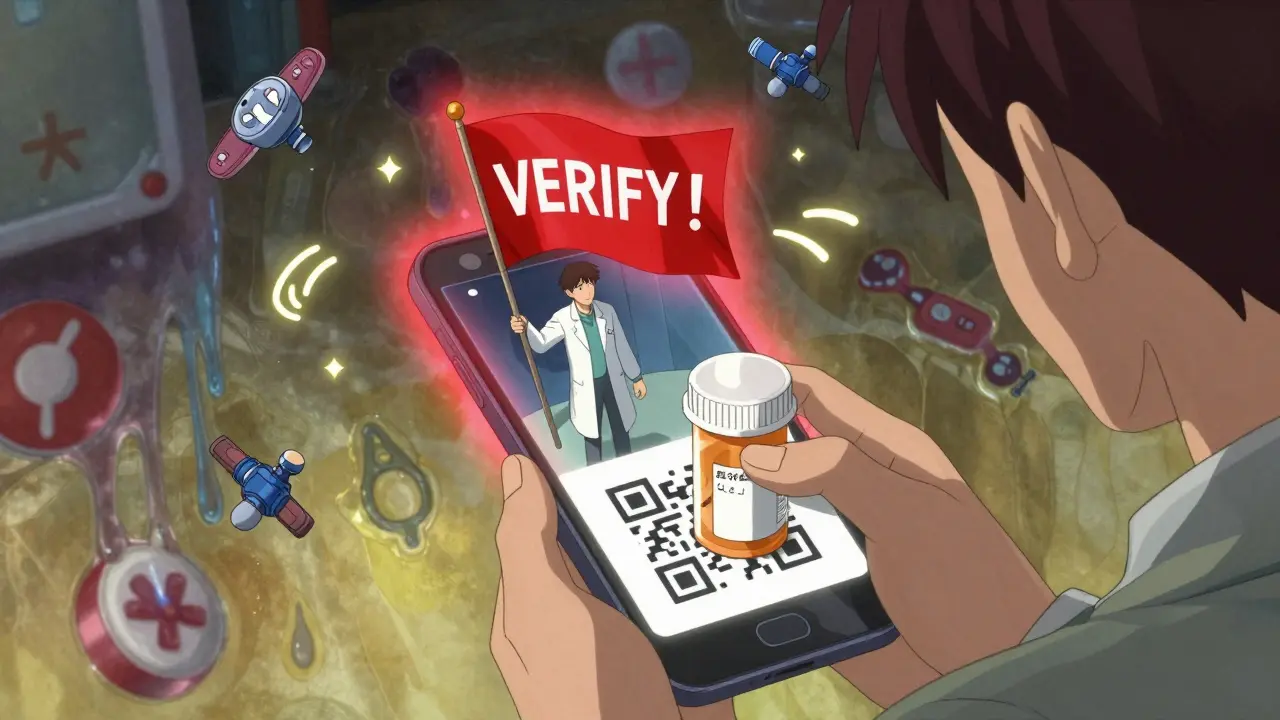
Technology is making verification easier. Most major pharmacies now have apps that let you scan the barcode on your label. The app checks the strength and quantity against the pharmacy’s records and alerts you if there’s a mismatch. Walgreens, CVS, and Kaiser Permanente all offer this. The scan takes 8 seconds instead of 47. That’s a big time-saver.
Some labels now have QR codes or NFC chips. Tap your phone on the label, and it pulls up the FDA’s official medication guide with dosage info, side effects, and warnings. In 2023, 94.7% of big pharmacy chains added these to high-risk medications like blood thinners, insulin, and seizure drugs.
But don’t rely on tech alone. Phones can die. Apps can glitch. The label is still your primary source. Use digital tools as a backup-not a replacement.
What’s Changing in 2025 and Beyond
The FDA is rolling out new rules in January 2025. High-alert medications-those that can cause serious harm if misused-will now need red borders around their strength info. Some states are testing color-coded labels: red for strong doses, yellow for medium, green for low. CVS and Walgreens are already testing smart labels with NFC chips that play audio instructions when scanned. That’s huge for people with vision problems or low literacy.
Right now, only 43.6% of people with limited health literacy understand their labels without help. That’s why these changes matter. Labels aren’t just for doctors and pharmacists-they’re for you. And you deserve to understand them clearly.
Final Tip: Make It a Habit
Checking your prescription label isn’t a one-time thing. Do it every time-even if it’s the same medicine you’ve taken for years. Strengths change. Formulations change. Pharmacies change. What was 5 mg last month might be 10 mg this month. Your body might need less now. Or more. You won’t know unless you check.
Keep a small notebook or use your phone’s notes app. Write down each medication, its strength, and how often you take it. When you get a new prescription, compare it to your list. You’ll catch mismatches fast. And over time, you’ll start recognizing patterns. You’ll know what your blood pressure pill looks like. You’ll know your antibiotic should be 500 mg, not 250 mg. That’s how you take control.
Medication safety isn’t just about what’s in the bottle. It’s about what you do with it. And you’re the most important part of the system.
How do I know if the strength on my prescription label is correct?
Compare the strength listed on the label to the exact dosage your doctor wrote on your prescription. If your doctor prescribed 25 mg and the label says 50 mg, that’s a mismatch. Always double-check units-mg, mcg, IU-and never assume. If you’re unsure, call your pharmacy or doctor’s office before taking the medication.
What’s the difference between medication strength and quantity?
Strength is how much active ingredient is in each dose-like 5 mg per tablet. Quantity is how many doses you received-like 30 tablets. Strength tells you how strong the medicine is; quantity tells you how much you have in total. Confusing the two can lead to taking too much or too little.
Why do some labels say mg and others say mcg?
Milligrams (mg) and micrograms (mcg) are different units of measurement. One milligram equals 1,000 micrograms. A mistake here can mean a 1,000-fold overdose. That’s why pharmacies now spell out “micrograms” instead of using “mcg” to avoid confusion. Always check the full word and never assume.
Can I trust the pharmacy to get the strength right?
Pharmacists are trained professionals, but they work under pressure. Human error, similar-looking drug names, and busy shifts can lead to mistakes. The FDA says the patient is the final safety checkpoint. Even with AI and barcode scanning, you should always verify the label yourself. Don’t rely on someone else to catch your error.
What should I do if I find a mistake on my label?
Do not take the medication. Return to the pharmacy immediately and ask to speak with the pharmacist. Bring your prescription or a photo of it. If they don’t fix it or dismiss your concern, call your doctor’s office. Your safety matters more than being polite. You have every right to demand a correct prescription.
Are there tools to help me read small print on labels?
Yes. Use your smartphone’s magnifier app (available on iPhone and Android) to zoom in on tiny text. Many pharmacies offer free large-print labels if you ask. You can also request high-contrast labels with bold black text on white background. Some apps let you scan the barcode and display the label info in larger text on your screen.


