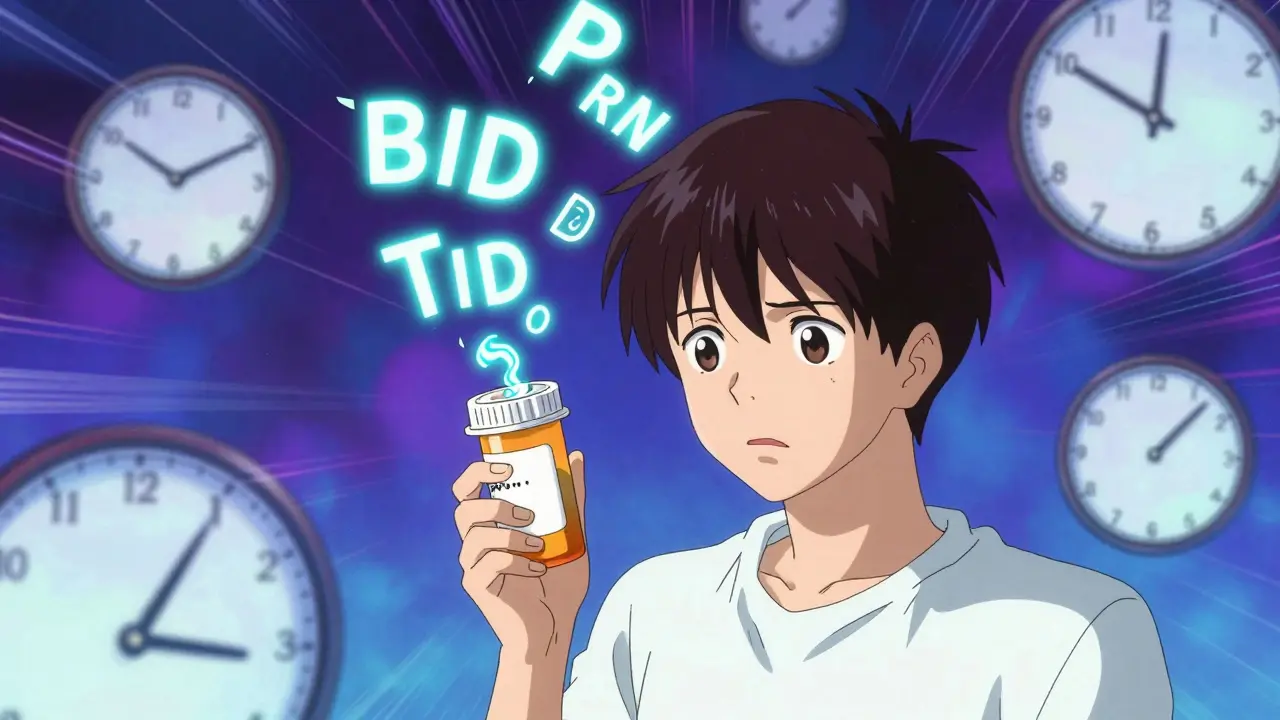

Ever looked at your prescription bottle and felt like you’re decoding a secret code? You’re not alone. Those tiny letters-BID, TID, PRN-aren’t random. They’re Latin abbreviations that have been used for over a century to tell you how and when to take your medicine. But if you don’t know what they mean, you could be taking your pills wrong. And that’s not just inconvenient-it can be dangerous.
What BID, TID, and PRN Really Mean
BID means twice a day. It comes from the Latin phrase bis in die. That doesn’t mean ‘morning and night’-though that’s what most people assume. It means roughly every 12 hours. So if you take your first dose at 8 a.m., the next should be around 8 p.m. Skipping the evening dose or taking both at breakfast throws off your blood levels and can make the medicine less effective.
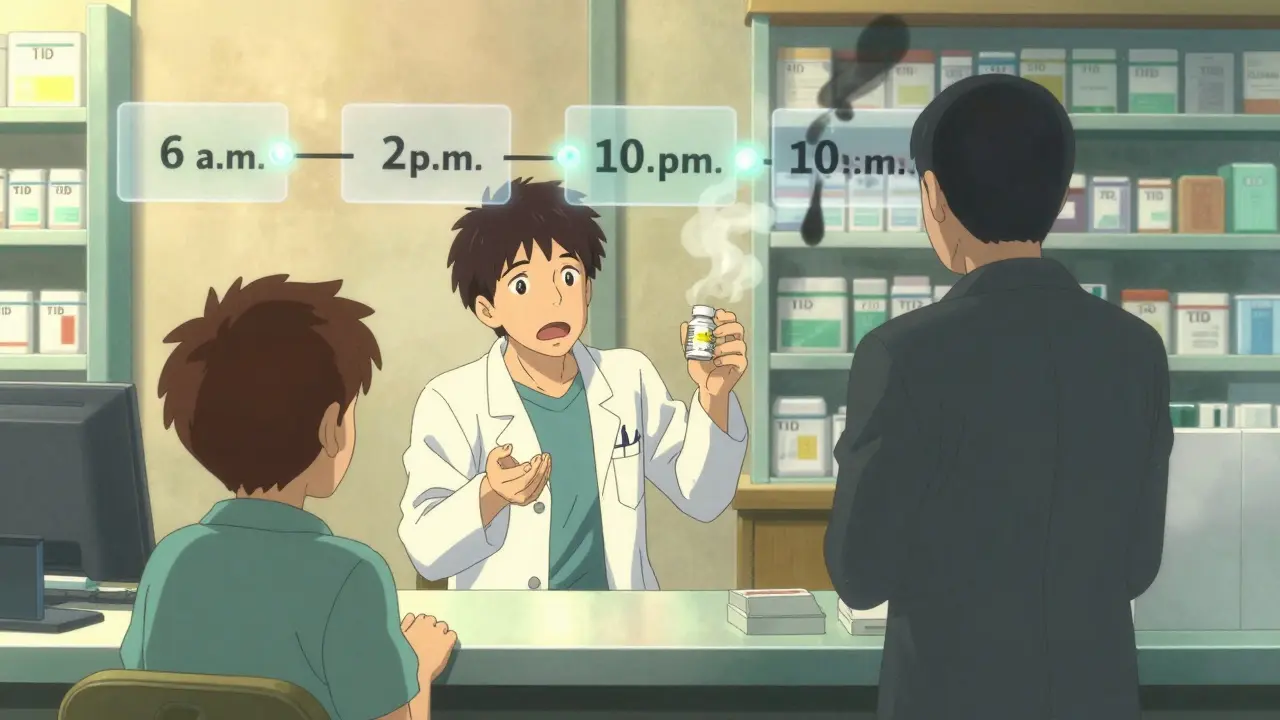
TID stands for three times a day, from ter in die. This one’s trickier. It’s not breakfast, lunch, and dinner. It’s every 8 hours. So if you start at 6 a.m., your next doses should be at 2 p.m. and 10 p.m. Many people miss the third dose because they’re asleep. But for antibiotics or blood pressure meds, timing matters. A 2020 Mayo Clinic study found that when TID doses were spaced more than 2 hours off schedule, drug effectiveness dropped by 38%.
PRN means as needed, from the Latin pro re nata. This is where most mistakes happen. PRN doesn’t mean ‘take it whenever you feel like it.’ It usually comes with limits. For example: ibuprofen 400mg PRN for pain, max 3 doses in 24 hours. That means you can take it up to three times, but not more. If you take it every 4 hours all day, you risk liver damage or stomach bleeding. Always check the maximum daily dose written on the label.
Other Common Abbreviations You’ll See
Here’s a quick guide to the most common ones you’ll find on your prescription:
- q.d. - once daily. Take it at the same time each day, like 8 a.m.
- q.i.d. - four times daily. That’s every 6 hours, like 6 a.m., 12 p.m., 6 p.m., 12 a.m.
- q.h. - every hour. Usually written as q4h (every 4 hours), q6h (every 6 hours), etc.
- ac - before meals. Take it 30 to 60 minutes before eating.
- pc - after meals. Take it within 30 minutes of finishing your meal.
- hs - at bedtime. Take it right before you go to sleep.
- po - by mouth. This just means it’s an oral pill or liquid, not a shot or cream.
These aren’t just random letters. They’re precise instructions. Take a blood thinner like warfarin-timing affects how well it works. Miss a dose or take it at the wrong time, and you could clot or bleed. A 2023 study from the University of California, San Francisco found that patients who understood their dosing schedule were 52% more likely to stick to it.
Why These Abbreviations Still Exist
You’d think we’d have ditched Latin by now. After all, we have electronic prescriptions, smartphones, and AI assistants. But here’s the reality: doctors still use them. In 2022, the FDA reported that 68% of U.S. prescriptions still included at least one Latin abbreviation. Why? Tradition. Many physicians were trained this way. Some think it’s faster. Others don’t know better.
But the risks are real. Between 2015 and 2019, over 1,200 medication errors were directly linked to misreading abbreviations. One case? A patient took insulin labeled ‘U’-thinking it meant ‘unit’-but the handwriting looked like a zero. They took 10 times the dose. That’s not rare. It’s common enough that The Joint Commission banned ‘U’ for units in 2006.
Even the way it’s written matters. ‘BID’ without periods? ‘bid’ in lowercase? That’s not standard. Some doctors write it that way. Pharmacists have to guess. And when they guess wrong, you pay the price.
What’s Changing-and What’s Not
Good news: change is coming. The United States Pharmacopeia (USP) has a new standard-General Chapter <17>-that bans all Latin abbreviations by December 31, 2025. Kaiser Permanente started switching to plain English in 2022. Their call volume to pharmacies dropped 29%. CVS and Walmart now include plain-English instructions on 78% of their labels. Independent pharmacies? Only 41% do.
But here’s the catch: you can’t wait for the system to fix itself. If your label says ‘TID,’ don’t assume you know what it means. Ask. That’s the most reliable safety net.
How to Get It Right: 5 Practical Steps
- Ask the pharmacist when you pick up your prescription. Say: ‘Can you explain how often I’m supposed to take this?’ They’re trained to help. In a 2022 Pharmacy Times survey, 89% of patients said they felt more confident after asking.
- Use a pill organizer with time labels. Buy one with AM/PM or 6 a.m., 2 p.m., 10 p.m. slots. It cuts confusion by half.
- Download a reminder app. Apps like Medisafe, MyTherapy, or even Apple Health can convert ‘BID’ to ‘Take at 8 a.m. and 8 p.m.’ and send alerts. Over 18 million people use them.
- Write it down. Before you leave the pharmacy, jot down the schedule in your own words. ‘Take 1 pill every 8 hours’ instead of ‘TID.’
- Do a ‘brown bag review’ once a year. Bring all your meds-bottles, supplements, OTC-to your doctor. They’ll spot mismatches, duplicates, or dangerous combinations.
One woman in Ohio took her TID antibiotic only twice a day because she thought ‘TID’ meant ‘three days.’ She finished the bottle in four days instead of ten. Her infection came back worse. She didn’t know. No one told her.

What to Do If You’re Still Confused
Don’t guess. Don’t assume. Don’t rely on memory.
If your label says ‘PRN for pain’ but you’re not sure how often, call the pharmacy. If it says ‘q4h’ but you don’t know what that means, look it up on the FDA’s patient guide or ask your pharmacist. If your doctor wrote ‘BID’ but didn’t specify morning and night, ask: ‘Should I take it at 8 a.m. and 8 p.m.?’
There’s no shame in asking. In fact, the most common tip from patients who’ve avoided mistakes? ‘If you can’t read it or don’t understand it, ask.’ That advice went viral on TikTok in March 2024 with 2.4 million views. The pharmacist who posted it? She’s now a national safety advocate.
Final Reminder: Timing Matters More Than You Think
Medications work best when your body gets them at consistent intervals. Antibiotics need steady levels to kill bacteria. Blood pressure meds need steady control. Even painkillers work better when spaced properly.
For TID, aim for 8-hour gaps. For BID, 12 hours. For q4h, every 4 hours-no more, no less. The American College of Clinical Pharmacy says a 15% variation is acceptable. So for TID, 6.8 to 9.2 hours is fine. But if you’re taking doses 14 hours apart? That’s not fine. That’s risking treatment failure.
And remember: ‘daily’ doesn’t mean ‘once a day at breakfast.’ It means once every 24 hours. Take it at bedtime? Fine. Take it at noon? Fine. Just be consistent.
What does BID mean on a prescription?
BID means twice a day, from the Latin bis in die. It should be taken approximately every 12 hours-for example, at 8 a.m. and 8 p.m.-to maintain steady drug levels in your bloodstream. Taking both doses at once or skipping the evening dose reduces effectiveness.
Is TID the same as three times a day after meals?
No. TID means three times a day, but not necessarily after meals. It means every 8 hours-like 6 a.m., 2 p.m., and 10 p.m.-to keep drug levels consistent. Taking it only at breakfast, lunch, and dinner can lead to uneven dosing and reduced effectiveness, especially with antibiotics or heart medications.
Can I take PRN medications whenever I want?
No. PRN means ‘as needed,’ but it always comes with limits. For example, ‘ibuprofen 400mg PRN for pain, max 3 doses in 24 hours’ means you can take it up to three times a day, but not more. Taking it too often can cause stomach bleeding, liver damage, or kidney issues. Always check the maximum daily dose on the label.
Why do pharmacies still use Latin abbreviations if they’re dangerous?
Many doctors were trained to use them, and some still write prescriptions by hand. Even with electronic systems, defaults sometimes carry over. While the U.S. Pharmacopeia is banning them by 2025, full transition takes time. Until then, it’s up to you to ask for clarification.
What should I do if my prescription label is unclear?
Call the pharmacy. Don’t guess. Pharmacists are trained to explain dosing instructions and are used to these questions. You can also ask your doctor during your next visit or use a medication app like Medisafe to convert abbreviations into plain English reminders.
Are there apps that help decode prescription labels?
Yes. Apps like Medisafe, MyTherapy, and Apple Health can translate abbreviations like BID, TID, and PRN into clear reminders with specific times. They also send alerts, track doses, and warn you if you’re taking too much. Over 18 million people use them to stay on track.
Next Steps: Protect Yourself
By the end of 2025, Latin abbreviations will be gone from U.S. prescriptions. But until then, you’re your own best defense. Don’t rely on memory. Don’t trust handwriting. Don’t assume you know what ‘TID’ means.
Write it down. Ask the pharmacist. Set a phone alarm. Use a pill box. Download an app. Do any one of these things, and you’ve just made your treatment safer.
Medication errors aren’t rare. They’re predictable. And they’re preventable. All it takes is one question.


