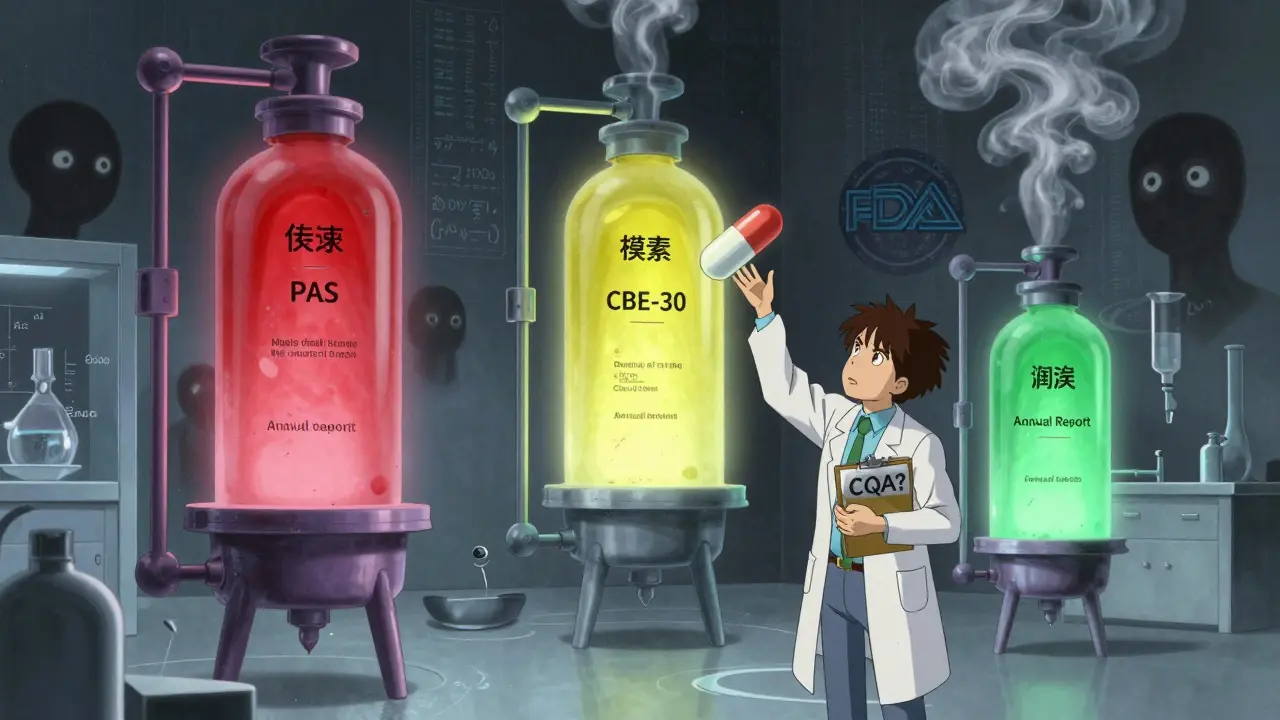

When you make a change to how a drug is made - even something as small as swapping out a pump or moving a mixing step to another room - the rules don’t disappear. In fact, they get stricter. For pharmaceutical companies, any tweak to the manufacturing process, equipment, facility, or quality controls after a product is approved by regulators isn’t just an internal decision. It’s a regulatory event. Get it wrong, and you could face a warning letter, a product recall, or even a halt to sales. The key isn’t just knowing what changed, but knowing how to report it - and when.
Why Manufacturing Changes Matter
A pill doesn’t care if it was made on Machine A or Machine B. But regulators do. That’s because even tiny changes can affect how the drug works in your body. A different mixer speed might change how fast the active ingredient dissolves. A new supplier for a raw material could introduce impurities. A shift in humidity during packaging might reduce shelf life. These aren’t theoretical risks. In 2022, 22% of all FDA warning letters were tied to improper handling of manufacturing changes. Of those, 37% involved equipment replacements that weren’t properly classified. The goal of the rules isn’t to slow things down. It’s to make sure that every batch of medicine you take is as safe and effective as the one approved in the clinical trial. If a change doesn’t affect quality, great - but you still have to prove it. And that proof has to be documented, reviewed, and submitted the right way.The Three Tiers of Change (FDA System)
In the U.S., the FDA uses a three-tier system to classify manufacturing changes. It’s simple in theory, but messy in practice. Each category has different rules for when you can make the change and how much you have to tell the agency.- Major changes (Prior Approval Supplement - PAS): These are the big ones. If you’re changing the chemical synthesis path for the active ingredient, moving production to a new country, or switching to a completely different type of sterilization oven, you need FDA approval before you make the change. No exceptions. You submit a detailed application with validation data, stability results, and batch comparisons. The FDA has 180 days to respond. If they say no, you can’t ship the product.
- Moderate changes (CBE-30): These are changes that could affect quality but aren’t high-risk. Think replacing a tablet press with an identical model from the same manufacturer, or changing the cleaning procedure for a filling line. You can implement the change after you submit a notification - but you must wait at least 30 days before shipping. This gives the FDA time to review and object if they think it’s riskier than you say.
- Minor changes (Annual Report): These are low-impact tweaks. Moving a non-critical lab test to a different bench within the same building, updating a printer label format, or switching to a different brand of gloves that meet the same specs. You don’t need to notify the FDA ahead of time. Just document it and include it in your next annual report, due within 60 days of your product’s approval anniversary.
How Other Regulators Do It
The U.S. isn’t the only player. Europe, Canada, and global bodies have their own systems - and they don’t always line up.- European Medicines Agency (EMA): Uses Type IA (minor, notify within 12 months), Type IB (moderate, must get approval before implementing), and Type II (major, full review before change). The big difference? EMA doesn’t have a “notify and wait” option like the FDA’s CBE-30. If it’s Type IB, you can’t touch the equipment until they say yes.
- Health Canada: Uses Level I (prior approval), Level II (notify and wait), and Level III (annual report). Their system mirrors the FDA closely, but their timelines are less rigid. No fixed 30-day clock.
- WHO Prequalification: For drugs sold in low-income countries, WHO requires a Comparability Protocol. This means you must prove, with data, that the product before and after the change is the same. No shortcuts.

What Counts as a “Change”?
It’s not just about new machines. A change can be:- Replacing a filter supplier - even if the specs are identical
- Switching from batch to continuous manufacturing
- Changing the temperature setting on a lyophilizer (freeze-dryer)
- Using a different batch of raw material from an approved vendor
- Updating software on a packaging line
How Companies Actually Handle This
Big pharma like Pfizer or Roche have teams of regulatory specialists, quality engineers, and validation experts whose whole job is managing change. They use risk assessment tools like FMEA (Failure Modes and Effects Analysis) to score each change. A 15-point checklist might ask: How many batches have been made with this process? Has this component failed before? Is the new equipment validated? What’s the impact on stability? But smaller companies? They’re stretched thin. One regulatory affairs manager on Reddit shared that classifying a tablet press replacement took 37 hours of team time because the API’s particle size specs were vague. That’s 37 hours they didn’t spend on new product applications or audits. Documentation is non-negotiable. For every change, you need:- Facility diagrams showing where the change happened
- Validation reports proving the new setup works
- Comparative data from at least three batches before and after the change
- A written justification explaining why it’s not a major change
The Future: Risk-Based and Real-Time
The system isn’t broken - it’s just outdated. Newer drugs, like gene therapies and mRNA vaccines, are made with highly sensitive processes. A single equipment change can wreck the whole batch. That’s why 78% of manufacturing changes for these advanced therapies now require PAS submissions. The FDA’s 2023 draft guidance pushes for using ICH Q9 quality risk management principles. That means more data, less guesswork. Companies are already testing real-time monitoring - sensors that track temperature, pressure, and humidity during production and send alerts if something drifts. By 2025, 40% of new change submissions could include this live data to prove stability. The goal? Make the system smarter. Not more paperwork. Less waiting. More trust in data.
What You Need to Do Today
If you’re managing manufacturing changes - whether you’re in a small lab or a global plant - here’s your checklist:- Identify the change. Write it down. Don’t assume it’s minor.
- Map it to your product’s CQAs. Does it affect dissolution, purity, potency, or stability?
- Review your internal risk assessment tool. If you don’t have one, build one using FMEA.
- Check the regulatory category for your region. Don’t use U.S. rules for Europe.
- When in doubt, consult the regulator. The FDA says so themselves: if you’re unsure, ask. It’s better than getting a warning letter.
- Document everything. Every email, every test, every decision. Audit trails are your shield.
- Train your team. Regulatory affairs specialists need 18 months of focused training to get this right. Don’t let someone new handle it alone.
Frequently Asked Questions
What happens if I make a manufacturing change without notifying the FDA?
You risk a warning letter, product seizure, or a forced recall. In 2022, 22% of FDA warning letters were for unapproved manufacturing changes. The agency doesn’t need to prove harm - just that you didn’t follow the rules. Even a small, harmless change can trigger enforcement if it wasn’t reported properly.
Can I use the same equipment from a different manufacturer?
It depends. If the new equipment has the same principle of operation, critical dimensions, and material of construction, it might qualify as a CBE-30 change. But if it’s a different design - even if it’s “better” - you likely need a PAS. The FDA’s 2022 guidance says “equivalent” means identical in function, not just performance. Don’t assume. Test it.
Do I need to re-validate the whole process after a minor change?
Not always. For minor changes, you may only need a targeted validation - like running three consecutive batches and comparing key quality data to historical results. But if the change affects a critical process parameter, full re-validation is required. The key is data: if your data shows no difference, you can argue for a limited validation. If you don’t have data, you can’t argue.
How long does a Prior Approval Supplement (PAS) take?
The FDA has 180 days to review a PAS, but it often takes longer if they request more data. Some companies spend 6-12 months preparing the submission because of the volume of required studies. Plan ahead. Don’t wait until the last minute to start your PAS.
Is there a way to speed up the approval process for moderate changes?
Yes - but only in Europe. Since January 2023, EMA allows “Type IB accelerated” review for certain equipment changes, cutting approval time from 60 to 30 days. The FDA doesn’t have a similar fast-track for CBE-30. The only way to reduce delays is to submit a complete, well-documented application with all required data upfront.
What’s the biggest mistake companies make with manufacturing changes?
Thinking a change is minor because it’s small. A $500 pump replacement can be a major change if it alters the flow rate of a critical solution. The mistake isn’t the cost - it’s the assumption. Always ask: “Could this affect the drug’s safety or effectiveness?” If the answer isn’t clear, treat it as a moderate or major change.


