
SSRI Metabolism Dosing Calculator
Personalized SSRI Dosing Calculator
Enter your metabolic status and select your SSRI to get personalized dosing recommendations based on your CYP2C19 and CYP2D6 genetic profile.
Your Dosing Recommendations
Starting an SSRI like sertraline or escitalopram shouldn’t feel like rolling dice. You take the pill, hoping it helps your depression, but instead you get nausea, dizziness, or insomnia-side effects so bad you quit. For many, this isn’t bad luck. It’s genetics. Two enzymes, CYP2C19 and CYP2D6, decide how fast your body breaks down these drugs. And if your genes make you a slow or fast metabolizer, standard doses can either flood your system or vanish before they work.
Why Your Genes Matter More Than You Think
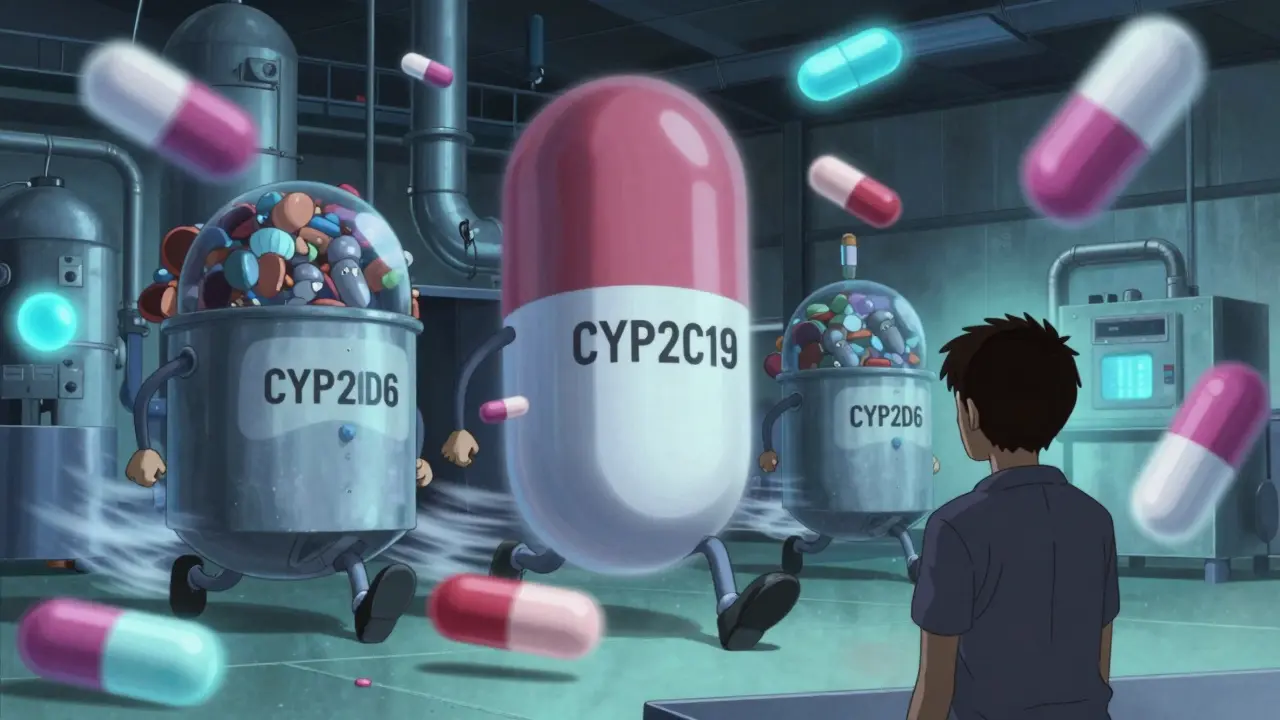
Most people assume antidepressants work the same for everyone. They don’t. Your body uses CYP2C19 and CYP2D6 to process SSRIs. These enzymes are like factory workers in your liver. Some workers are slow, some are fast, and some are barely there. That’s because of your genes. If you inherit two slow versions of CYP2C19, you’re a poor metabolizer. Your body can’t clear escitalopram or citalopram quickly. That means the drug builds up. One study found poor metabolizers had 2.3 to 3.5 times higher blood levels of escitalopram than normal metabolizers. That’s not a small difference-it’s enough to cause serious side effects.
On the flip side, if you’re an ultrarapid metabolizer, your body clears the drug too fast. A patient on 20mg of escitalopram might feel nothing because it’s gone before it can act. Increasing the dose to 40mg fixed it for them. That’s not stubbornness or non-compliance. That’s biology.
CYP2D6 does the same for fluoxetine, paroxetine, and venlafaxine. Poor metabolizers here are 2.7 times more likely to have bad reactions to venlafaxine. One 45-year-old woman developed severe dizziness and insomnia on 75mg of venlafaxine. Her test showed she was a CYP2D6 poor metabolizer. Cutting the dose in half made her symptoms disappear. She didn’t need a new drug. She just needed the right dose.
What the Tests Actually Measure
Pharmacogenomic tests don’t scan your whole genome. They look at specific spots in CYP2C19 and CYP2D6 where variations matter. CYP2D6 has over 100 known variants. CYP2C19 has around 35. These combine into four main metabolic types:
- Poor metabolizer (PM)
- Intermediate metabolizer (IM)
- Normal metabolizer (NM)
- Ultrarapid metabolizer (UM)
CYP2C19 adds a fifth: rapid metabolizer (RM). These aren’t guesses. They’re based on real DNA patterns. Testing uses targeted arrays or sequencing-not cheap at-home kits. Standard DNA tests like 23andMe can’t read these genes accurately because CYP2D6 has tricky duplicated regions and pseudogenes that confuse basic tests.
Accuracy? Commercial tests are 95-99% reliable. Turnaround time? Usually 1 to 3 weeks. You send a saliva sample, wait, and get a report that says: “You’re a CYP2D6 poor metabolizer. Avoid paroxetine. Use sertraline at lower dose.”
Which SSRIs Are Affected?
Not all antidepressants are created equal when it comes to these enzymes. Here’s what breaks down where:
- CYP2C19: citalopram (Celexa), escitalopram (Lexapro), sertraline (Zoloft)
- CYP2D6: fluoxetine (Prozac), paroxetine (Paxil), fluvoxamine (Luvox), venlafaxine (Effexor XR), duloxetine (Cymbalta), vortioxetine (Trintellix)
Notice something? Sertraline is processed by CYP2C19, not CYP2D6. That’s why some doctors prefer it for patients with known CYP2D6 issues. It’s not a magic bullet, but it’s a safer bet.
And here’s the catch: the FDA now lists pharmacogenetic warnings for over 10 antidepressants. Citalopram’s label says: “Avoid doses above 20mg/day in CYP2C19 poor metabolizers.” That’s not a suggestion. It’s a warning built into the drug’s official documentation.

Does Testing Actually Improve Outcomes?
Yes-but not always the way you’d expect.
Studies show clear differences in drug levels. Poor metabolizers have higher blood concentrations. Ultrarapid metabolizers have lower ones. That’s solid science. But here’s where it gets messy: higher drug levels don’t always mean better mood. A study of 5,843 people found no consistent link between CYP2C19 genotype and whether someone felt better on escitalopram. Their blood levels changed, but their depression didn’t always improve.
What does change? Side effects. Patients with poor metabolizer status report 2.8 to 3.2 times more severe side effects with citalopram and paroxetine. That’s the real win. Testing doesn’t guarantee you’ll feel better. But it cuts your odds of feeling awful.
One meta-analysis of 94 studies found 30-50% of people on standard antidepressants get side effects severe enough to quit. Pharmacogenomic testing could reduce that by 20-30% in high-risk groups. That’s not a cure. But it’s a major step toward avoiding the trial-and-error hell so many endure.
Cost, Coverage, and Real-World Barriers
Testing costs $250-$500 out of pocket. Insurance? Only 62% of U.S. insurers cover it for antidepressants as of mid-2024. That’s changing, but slowly. Medicare doesn’t cover it yet. Private plans vary. Some require you to try two failed medications first.
Doctors aren’t always trained to interpret the results. A 6-hour CME course from the American Psychiatric Association helps, but most haven’t taken it. That’s why pharmacists with board certification in pharmacogenomics are becoming essential. There are only about 1,200 in the U.S.-but they’re the ones who can read the report and say, “Don’t use paroxetine. Switch to sertraline at 50mg.”
Tools like CPIC’s free online dosing guidelines make it easier. You plug in the gene result and the drug, and it tells you: “Reduce dose by 50%” or “Avoid entirely.” No guesswork.

What Experts Really Say
Dr. Craig Bousman, a pharmacogenomics expert, puts it simply: “Poor metabolizers get too much drug. Ultrarapid metabolizers get too little.” That’s the core.
But Dr. Pedro Ruiz, a psychiatrist at the University of Miami, warns: “Genetics is just one piece. Stress, sleep, other meds, and even gut health matter too.” He’s right. A gene test won’t fix a patient who’s not sleeping or who’s drinking alcohol daily. But it removes one big variable from the equation.
The Dutch Pharmacogenetics Working Group sometimes disagrees with U.S. guidelines. For example, they recommend higher doses for CYP2C19 poor metabolizers on escitalopram than CPIC does. That’s why you need to know which guidelines your provider follows.
Who Should Get Tested?
You don’t need to test everyone. But you should consider it if:
- You’ve had side effects with one or more SSRIs and had to stop
- You’ve tried two or more antidepressants without success
- You have a family history of bad reactions to antidepressants
- You’re starting treatment and want to avoid the trial-and-error phase
It’s not a crystal ball. But it’s the closest thing we have to personalized dosing right now.
What’s Next?
The NIH just launched a $15.2 million study called GUIDED-2. It’s tracking 5,000 people with treatment-resistant depression across 75 clinics. They’re testing whether gene-guided prescribing leads to faster recovery and fewer dropouts. Results won’t be in until 2027, but early signs are promising.
By 2026, some clinics plan to use polygenic risk scores-combining CYP2D6, CYP2C19, and other genes with clinical data to predict response. That’s the future. But today? Start with the genes you know work: CYP2C19 and CYP2D6.
78% of psychiatrists say they’ll use more testing in the next three years. That’s not hype. It’s experience. More doctors are seeing patients who finally feel better after a simple gene test changes their dose.
If you’ve been stuck in the antidepressant loop-side effects, quitting, trying again, failing again-this isn’t science fiction. It’s a real tool. And it’s available now.
Is pharmacogenomic testing for SSRIs covered by insurance?
Coverage varies. As of 2024, only about 62% of major U.S. insurers cover CYP2C19 and CYP2D6 testing for antidepressants. Medicare doesn’t cover it yet. Some private plans require you to try two failed medications first. Always check with your insurer before ordering the test.
Can I use 23andMe or AncestryDNA for this testing?
No. Standard direct-to-consumer DNA tests like 23andMe don’t accurately read CYP2D6 or CYP2C19. These genes have complex structural variants and pseudogenes that require targeted sequencing or specialized genotyping arrays. Using consumer DNA results for antidepressant dosing can lead to dangerous errors.
What if my test shows I’m a poor metabolizer-do I have to avoid SSRIs entirely?
No. You don’t avoid them-you adjust them. For example, if you’re a CYP2C19 poor metabolizer, you might take escitalopram at half the standard dose. Or switch to sertraline, which is less affected by CYP2C19. The goal isn’t to stop treatment-it’s to make it safer and more effective.
How long does it take to get test results?
Typically 1 to 3 weeks from the time your sample is sent to the lab. Some clinics offer expedited testing for $100-$150 extra, with results in 5-7 days. Most providers wait for results before prescribing to avoid trial-and-error dosing.
Do I need to retake the test if I switch medications?
No. Your genes don’t change. Once you know your CYP2C19 and CYP2D6 status, that result applies to all future medications processed by those enzymes. You can use it for any SSRI, SNRI, or even some tricyclic antidepressants down the line.
Is pharmacogenomic testing worth it if I’m just starting antidepressants?
Yes-if you want to avoid the common 30-50% side effect rate. Starting with a gene-guided dose can prevent weeks of nausea, dizziness, or insomnia. It’s not a guarantee you’ll feel better, but it greatly reduces the chance you’ll quit because you felt worse.


