

REMS Program Complexity & Cost Estimator
Pharmaceutical sponsors bear the full cost of implementing REMS programs. Use this tool to estimate how much a company might spend annually to maintain specific safety safeguards for a high-risk medication.
Analysis Results
Complexity Level
--
Estimated Annual Base Cost
--
Projected Total Annual Burden
--
Cost Breakdown:
Imagine needing a life-saving medication, but having to wait five days just to get the first prescription filled. For many patients taking high-risk drugs, this isn't a hypothetical scenario; it's a daily reality caused by REMS programs, or Risk Evaluation and Mitigation Strategies. These are formal oversight systems created by the U.S. Food and Drug Administration (FDA) to ensure that certain medications provide more benefit than harm. While standard drug labels list side effects, REMS goes further by adding specific hurdles-like special doctor certifications or hospital monitoring-to manage serious risks.
The system might feel like bureaucratic red tape, but it exists because some drugs carry severe dangers if not used correctly. Think of isotretinoin for acne or clozapine for schizophrenia. Used properly, they change lives. Used carelessly, they can cause birth defects or fatal blood conditions. This guide breaks down how these programs work, who is affected, and what you can do to navigate them smoothly.
What Exactly Is a REMS Program?
A REMS program is a set of strategies required by the FDA to minimize the risk of serious adverse events associated with specific prescription drugs. It was formally established by the Food and Drug Administration Amendments Act (FDAAA) in 2007, which added Section 505-1 to the Federal Food, Drug, and Cosmetic Act. Before this, risk management was less standardized. The concept dates back to the 1980s when drugs like thalidomide and isotretinoin were restricted due to their potential to cause severe birth defects.
Not every drug needs a REMS. In fact, about 95% of approved medications rely on standard labeling and routine adverse event reporting. REMS is reserved for the small percentage of drugs where the risk is significant enough to require extra safeguards beyond what a simple warning label can do. The goal isn't to eliminate all risk-that's impossible for many powerful therapies-but to ensure the benefits outweigh the risks for the patient.
How REMS Differs from Standard Safety Measures
You might wonder how REMS is different from the black box warnings you see on other prescriptions. Standard labeling communicates known risks to doctors and patients. REMS actively manages those risks through specific actions. For example, a standard label might say "monitor liver function." A REMS program might require a certified lab test before every single dose, with results sent directly to a central registry before the pharmacy can release the medication.
| Feature | Standard Drug Labeling | REMS Program |
|---|---|---|
| Scope | All approved drugs | High-risk drugs only (~5%) |
| Primary Tool | Patient Information Leaflet | ETASU (Elements to Assure Safe Use) |
| Responsibility | FDA & Sponsor | Sponsor (Pharma Company) leads implementation |
| Access Barrier | Minimal | Can add days to weeks for initial fill |
| Monitoring | Self-reported or routine check-ups | Mandatory registries, labs, or facility checks |
A key difference is responsibility. With standard safety monitoring, the FDA tracks data broadly. With REMS, the pharmaceutical company (the sponsor) must develop, fund, and maintain the entire program. They have to build the websites, train the doctors, and manage the patient registries. This shifts a significant burden onto the industry while keeping the FDA as the regulatory overseer.
The Core Components: ETASU and Medication Guides
Most REMS programs include two main parts: a Medication Guide and Elements to Assure Safe Use (ETASU). The Medication Guide is a plain-language document given to patients at every refill. It explains the serious risks in easy-to-understand terms. You've likely seen these for common drugs like warfarin or insulin.
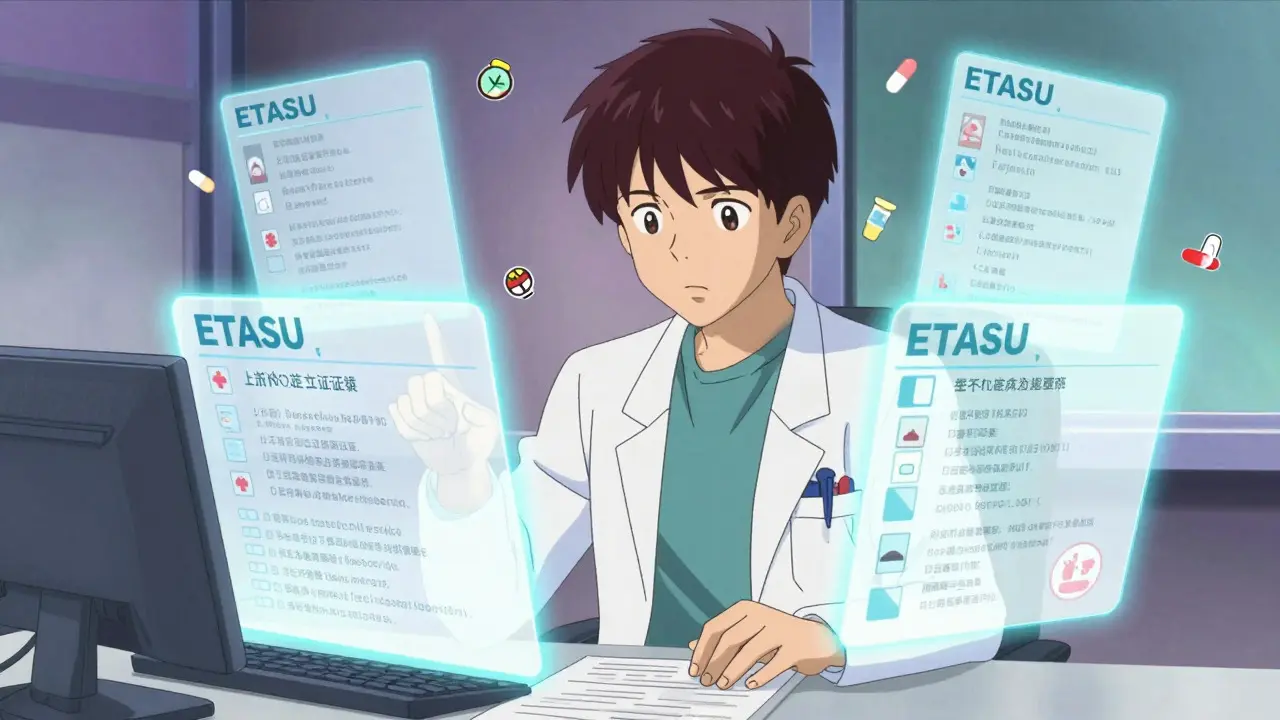
ETASU is where things get stricter. These are the active controls that prevent unsafe use. Depending on the drug, ETASU might require:
- Prescriber Certification: Doctors must complete online training to be allowed to prescribe the drug.
- Patient Enrollment: Patients must register in a national database before getting their first dose.
- Laboratory Monitoring: Regular blood tests are mandatory to check for toxicity.
- Special Dispensing Settings: Some drugs can only be given in a hospital or clinic where staff can monitor the patient immediately after administration.
Take Zyprexa Relprevv, an injectable antipsychotic for schizophrenia. Because it can cause post-injection delirium sedation syndrome in less than 1% of cases, the REMS requires it to be administered only in certified healthcare facilities. Patients must stay for three hours after the injection so nurses can watch for signs of coma or severe sedation. Without this REMS, the drug would be too risky to distribute widely.
Who Is Affected by REMS Programs?
While REMS sounds technical, it impacts four main groups: patients, prescribers, pharmacists, and the pharmaceutical sponsors. Each group has a specific role in keeping the system running.
Patients
For patients, REMS often means extra steps. You might need to call a hotline, complete online quizzes, or visit a specialized clinic. A 2019 study in JAMA Internal Medicine found that REMS drugs took an average of 5.4 days longer to reach the first prescription compared to non-REMS drugs. For people with rare diseases who already travel long distances for care, this delay can be frustrating. However, for many, the peace of mind knowing their high-risk medication is being closely monitored is worth the effort.
Prescribers and Pharmacists
Doctors and pharmacists face administrative burdens. A 2022 survey by the American Medical Association showed that 68% of physicians reported delays in starting REMS-required meds. Pharmacists spend an estimated 2-5 extra hours per week managing these requirements. For instance, dispensing clozapine requires verifying weekly blood counts for the first six months. If the electronic health record doesn't sync with the REMS portal, the pharmacist has to manually check the registry, slowing down the workflow significantly.
Pharmaceutical Sponsors
The companies making the drugs bear the cost. Industry estimates suggest the pharmaceutical sector spends about $1.2 billion annually on REMS implementation. Simple programs might cost $500,000 a year, while complex ones with registries and specialized dispensing can exceed $15 million. If a company fails to follow the rules, the FDA can issue warning letters or fines. In fiscal year 2022, the FDA issued 17 warning letters for non-compliance, including a $2.1 million settlement with a generic manufacturer for poor clozapine REMS execution.
Common Challenges and Real-World Examples
Despite its goals, REMS isn't perfect. One major criticism is that it creates unnecessary barriers. Dr. Aaron Kesselheim from Harvard Medical School testified before the Senate in 2021 that some programs, like the one for extended-release opioids, added admin tasks without clear safety benefits. Meanwhile, Dr. Robert Temple from the FDA argued in 2022 that REMS has been essential for bringing critical therapies to market that would otherwise be too risky to approve.
Interoperability is another headache. As of 2023, only 35% of REMS programs had direct integration with electronic health records. This means data often sits in silos. To fix this, the FDA launched the REMS Integration Initiative. By late 2023, they had standardized 22 of the 78 active programs onto a single platform, aiming to reduce the administrative load on healthcare providers.
Another challenge is equity. The National Organization for Rare Disorders (NORD) noted in 2023 that current implementations often fail to account for the transportation and scheduling challenges faced by rare disease patients. If a drug requires monthly visits to a specialized center, rural patients may struggle to comply, potentially leading to treatment gaps.

Current Trends and Future Developments
The landscape of REMS is evolving. As of October 2023, there are 78 active REMS programs covering about 150 medications. That's a 230% increase from 2015. Oncology drugs make up the largest share, accounting for 37.2% of all programs. This growth reflects the rise of targeted cancer therapies that are highly effective but carry specific, manageable risks.
The FDA is also modernizing the approach. Their 2024-2026 Strategic Plan includes using digital health technologies. Pilot programs are testing smartphone apps for real-time patient monitoring for certain anticoagulants. This could replace some in-person visits with remote data tracking, making compliance easier for patients.
Interestingly, REMS programs can end. In August 2023, the FDA approved the first "sunset" of a REMS program for thalidomide after 20 years. The agency determined that improved understanding of the risks made the strict mitigation strategies no longer necessary. This shows that REMS is dynamic, not permanent.
How to Navigate Your REMS Prescription
If you or a loved one has been prescribed a drug with a REMS, here’s how to handle it efficiently:
- Ask for the Medication Guide Early: Don't wait until pickup. Ask your doctor to send the digital version or printout so you can review it at home.
- Complete Training Promptly: If your doctor needs to certify, ask them to do it during your first appointment. Delays here cause most prescription holds.
- Check Pharmacy Compatibility: Not all pharmacies are set up for every REMS. Call ahead to ensure they can verify your eligibility through the required portal.
- Keep Records: Save confirmation emails from enrollment portals. If a lab result is delayed, having proof of submission can help resolve disputes quickly.
- Plan for Follow-Ups: If the drug requires regular blood tests or clinic visits, schedule them before your next refill date to avoid running out of medication.
By staying proactive, you can minimize the friction that REMS introduces. Remember, these steps exist to keep you safe, not to slow you down unnecessarily.
Frequently Asked Questions
Does every prescription drug have a REMS?
No. Only about 5% of approved drugs require a REMS. Most medications rely on standard labeling and routine monitoring. REMS is reserved for drugs with serious risks that need additional safeguards.
Who pays for the REMS program costs?
The pharmaceutical company that makes the drug (the sponsor) pays for developing and maintaining the program. This includes funding the patient registries, training materials, and verification portals. These costs are factored into the overall price of the medication.
Can a REMS program be removed later?
Yes. The FDA can modify or terminate a REMS if new data shows the risk is better understood or if alternative management strategies are available. For example, the REMS for thalidomide was sunset in 2023 after two decades of successful use.
Do generic drugs have the same REMS as brand-name versions?
Generally, yes. If a brand-name drug has a REMS, the generic version usually inherits the same requirements to ensure consistent safety standards. However, the FDA can sometimes allow simplified REMS for generics if the risk profile is identical and the barrier to entry is reduced.
What should I do if my REMS prescription is delayed?
First, contact your pharmacist to identify the missing step (e.g., unverified lab result or incomplete doctor certification). Then, reach out to your prescriber to expedite any required documentation. If the delay persists, you can contact the REMS support line provided in your Medication Guide for assistance.