

When you switch lawyers in the middle of a case, it seems simple: you sign a form, hand over your file, and the new attorney takes over. But if you’re in federal court, that simple step could derail your case entirely. The truth is, substitution rules between state and federal courts aren’t just different-they’re often incompatible. And for attorneys who move between systems, getting it wrong isn’t just embarrassing. It’s expensive, risky, and can cost clients their legal rights.
Why Substitution Rules Even Exist
Substitution rules aren’t about bureaucracy for the sake of it. They exist to protect the integrity of court proceedings. Courts need to know who’s representing whom, ensure attorneys are qualified, and prevent last-minute delays that disrupt trials. But here’s the catch: federal courts and state courts have completely different philosophies about how to handle attorney changes. Federal courts prioritize control. They want to know why you’re switching, when you’re switching, and whether the new lawyer is properly licensed to appear before them. State courts, on the other hand, tend to trust clients. If a client wants a new lawyer, most states let them do it with a signature and a quick filing. No explanation needed. No court hearing. No waiting. This mismatch creates real problems. Imagine an attorney who practices in both systems. They file a substitution motion in federal court using the same form they use in state court. The federal court rejects it. The client’s case stalls. The new lawyer can’t enter the case. And suddenly, you’ve got a malpractice claim brewing.Federal Rules: Strict, Uniform, and Unforgiving
Federal substitution is governed by Rule 83 of the Federal Rules of Civil Procedure, backed up by local rules in each district. And yes, local rules matter. What’s allowed in New York might be illegal in Texas-even within the same federal circuit. In federal court, you need a formal motion signed by three people: the outgoing attorney, the incoming attorney, and the client. Even if you’re switching from one partner to another in the same law firm, you still need court approval. No exceptions. The Eastern District of New York requires you to file a letter motion with a magistrate judge. The Central District of California demands electronic signatures. The District of Columbia still requires ink-on-paper filings. There’s no national standard. Federal courts also demand justification. Why are you changing lawyers? Is it because the client is unhappy? Is the original lawyer overworked? Is the new lawyer an expert in tax law for a federal tax case? You have to say. And you have to say it clearly. In the Second Circuit, 31% of substitution motions filed within 30 days of trial were denied in 2023. Courts don’t want surprises right before a hearing. And don’t forget the qualification check. If you’re stepping into a federal tax court, you need to prove you’re authorized to practice before the IRS. That’s Rule 83.12. You can’t just show up with a state bar card. You need IRS credentials. That’s not something most state attorneys think about.State Rules: Client-Centered and Chaotic
State courts are a different world. In 32 states-including California, Texas, and New York-you can substitute counsel without any court involvement at all. All you need is a signed agreement between the old and new attorneys, and a notice to the client. No motion. No judge. No waiting. Florida goes even further. Under Rule 4-1.16(c), the client has an absolute right to fire their lawyer at any time. The court doesn’t get involved unless the lawyer refuses to leave. Virginia lets attorneys swap out without even showing up in court. You just file a notice and move on. But here’s the catch: state rules aren’t consistent even within the same state. In Texas, Harris County requires electronic filings. Brewster County, a rural area with fewer resources, still requires paper forms mailed in. In New Jersey, you need seven days’ notice. In Pennsylvania, it’s 14. And if you’re in a county that doesn’t have a standardized form? You’re stuck drafting your own. This inconsistency is a nightmare for attorneys who handle cases across multiple counties. One lawyer told the American Bar Association forum that they filed a substitution in two different counties in the same state-and got two completely different responses. One accepted it. The other demanded a hearing. No one could explain why.
The Real Danger: Mixing Up the Rules
The biggest risk isn’t ignorance. It’s assumption. A 2024 survey by LegalMalpractice.com found that 68% of substitution-related malpractice claims came from attorneys who used state procedures in federal court. One Chicago attorney filed a standard Illinois substitution form in the Northern District of Illinois federal court. He thought, “It’s the same state. It should work.” It didn’t. The court struck his motion. His client’s representation was suspended for 17 days. He lost $8,500 in billable hours and had to refile everything properly. Another attorney in New York, used to filing substitutions via email in state court, tried the same thing in the Eastern District of New York. The court rejected it outright. No warning. No grace period. Just a notice that the substitution was void. The American Bar Association’s Formal Opinion 502 (March 2024) made it clear: if you’re practicing in federal court, you follow federal rules-even if your state allows more flexibility. Violating federal substitution procedures counts as professional misconduct under Model Rule 3.4.What Happens When You Get It Wrong?
The consequences aren’t theoretical. In 2023, the Federal Judicial Center reported that 18% of all non-merits dismissals in pro hac vice admissions were due to substitution errors. That means cases got thrown out not because they were weak, but because the lawyer didn’t file the right form. Clients suffer too. Delays mean missed deadlines. Missed deadlines mean lost evidence. Lost evidence means lost cases. And when a client loses because their lawyer didn’t know the rules, the legal system pays the price-in time, money, and trust. A 2024 study by the National Center for State Courts found that attorneys who switch between state and federal practice take 6 to 12 months to get comfortable with substitution rules. That’s half a year of costly mistakes.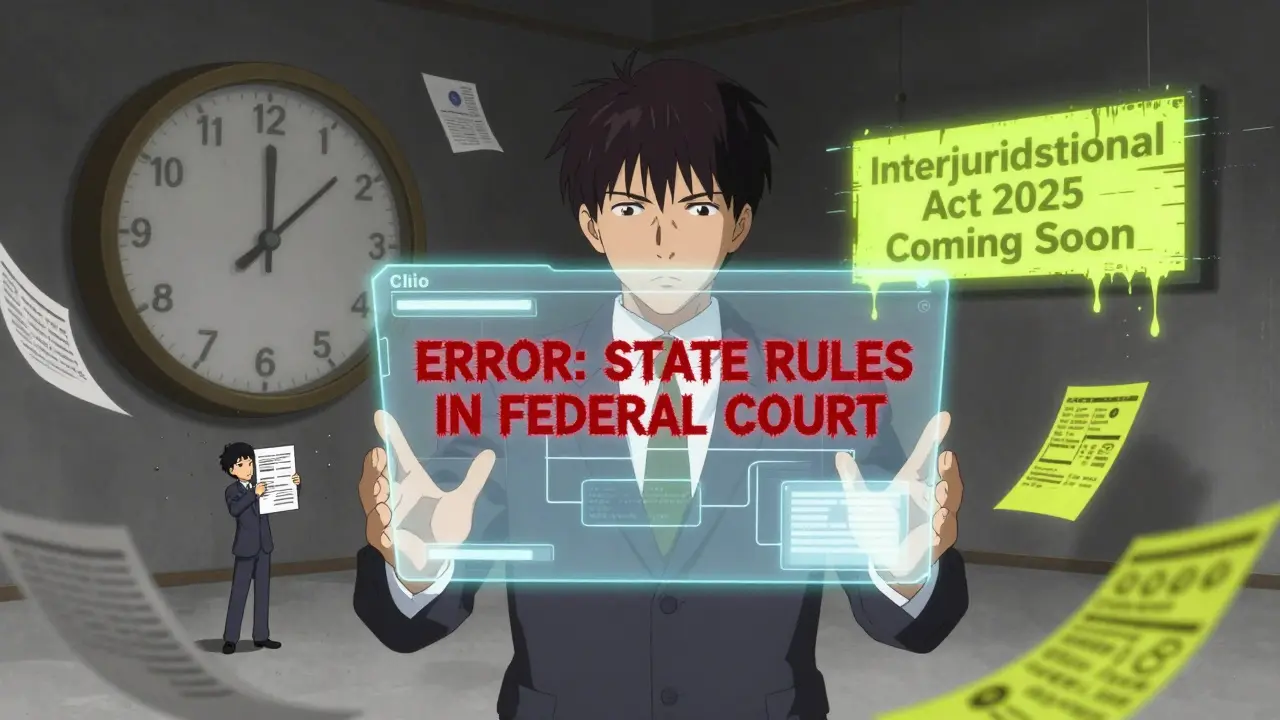
How to Avoid the Trap
There’s no magic trick. But there are practical steps:- Never assume state rules apply in federal court. Even if you’re in the same building, the rules are different.
- Check local federal rules. Every district has its own. Go to the court’s website. Look for “Local Rules” or “Procedural Guidelines.”
- Use jurisdiction-specific templates. Keep separate folders: one for state substitutions, one for federal. Don’t mix them.
- File early. Don’t wait until the last minute. Federal courts are strict about timing, especially near trial dates.
- Know the qualifications. If it’s a specialized court-tax, immigration, bankruptcy-check what credentials the new attorney needs.
Is Change Coming?
There’s growing recognition that this patchwork system doesn’t work. The American Bar Association is reviewing Model Rule 1.16 to address cross-jurisdictional conflicts. The Uniform Law Commission is drafting the Interjurisdictional Legal Practice Act, expected by December 2025. If passed, it would create baseline substitution standards for attorneys working across state and federal lines. Meanwhile, the Federal Judicial Center launched a pilot program in 12 districts in January 2025 to streamline filings. Early results show a 15% drop in processing time. That’s progress. But for now, the rules remain split. Federal courts demand precision. State courts value speed and autonomy. And until those systems align, attorneys must treat them as two different legal languages.What You Need to Remember
- Federal courts require court approval for every substitution, even within the same firm.- Most state courts allow substitution with a signed form-no court involvement.
- You cannot use state procedures in federal court. Doing so is professional misconduct.
- Local federal rules vary. Always check them before filing.
- Timing matters. Motions filed too close to trial are often denied in federal court.
- Specialized courts (tax, immigration, etc.) have extra credential requirements.
- Mistakes cost money, time, and cases.
If you’re switching lawyers, don’t treat it like changing your dentist. This is the court system. One wrong step, and the whole case could unravel.
Can I substitute my lawyer in federal court without a judge’s approval?
No. Federal courts require formal court approval for every substitution, even if you’re switching to another attorney in the same law firm. You must file a motion signed by the outgoing attorney, incoming attorney, and client. The judge must review and approve it before the new attorney can enter the case.
What’s the fastest way to substitute counsel in state court?
In 32 states, including California, Texas, and New York, you can substitute counsel without any court involvement. All you need is a signed agreement between the old and new attorneys, and a notice filed with the court. No motion, no hearing, no waiting. Some states, like Florida, even let the client fire their lawyer without any court notice at all.
Why do federal courts require detailed reasons for substitution?
Federal courts prioritize judicial efficiency and case stability. They want to prevent last-minute delays, tactical substitutions meant to stall proceedings, or unqualified attorneys entering cases. Requiring a justification helps judges assess whether the substitution will disrupt the trial schedule or compromise the fairness of the process.
Can I use my state bar license to practice in federal court?
Not always. While a state bar license lets you practice in state courts, federal courts often require additional qualifications. For example, attorneys practicing in federal tax court must be accredited by the IRS. Some courts also require attorneys to apply for admission pro hac vice or meet specific continuing education requirements.
What happens if I file a substitution using state rules in federal court?
Your motion will likely be rejected, and your new attorney won’t be allowed to enter the case. The court may strike the filing, delay proceedings, or even impose sanctions. In some cases, clients have lost rights because their representation was suspended due to improper substitution. The American Bar Association considers this professional misconduct under Model Rule 3.4.
Are there tools to help avoid substitution errors?
Yes. Legal practice management software like Clio’s Jurisdictional Compliance Module now flags substitution requirements based on the court. Firms using these tools saw a 39% reduction in substitution errors in a 2024 study. Keeping separate templates for state and federal filings is also a proven best practice.
Is there a trend toward harmonizing state and federal substitution rules?
Yes. The Uniform Law Commission is drafting the Interjurisdictional Legal Practice Act, expected by December 2025, which would create common standards for attorneys practicing across state and federal courts. The American Bar Association is also reviewing its Model Rules. But until then, attorneys must navigate the current patchwork system carefully.