
Vaccination Safety Checker
Choose a vaccine to check its category:
Analysis for ...
If you are taking medications to dampen your immune system, the standard vaccination schedule doesn't apply to you. It's not as simple as just showing up at a pharmacy; a wrong choice in vaccine type could actually cause the disease you're trying to prevent. The core challenge for anyone on immunosuppressants is balancing the urgent need for protection against infections with the risk that their body cannot handle a "live" version of a virus.
Current guidance from the Infectious Diseases Society of America (IDSA) and the CDC makes a sharp distinction between live attenuated and inactivated vaccines. While one is generally safe, the other can be dangerous. Understanding this difference-and exactly when to get your shots-is the key to staying safe without compromising your treatment.
The Big Difference: Live vs. Inactivated Vaccines
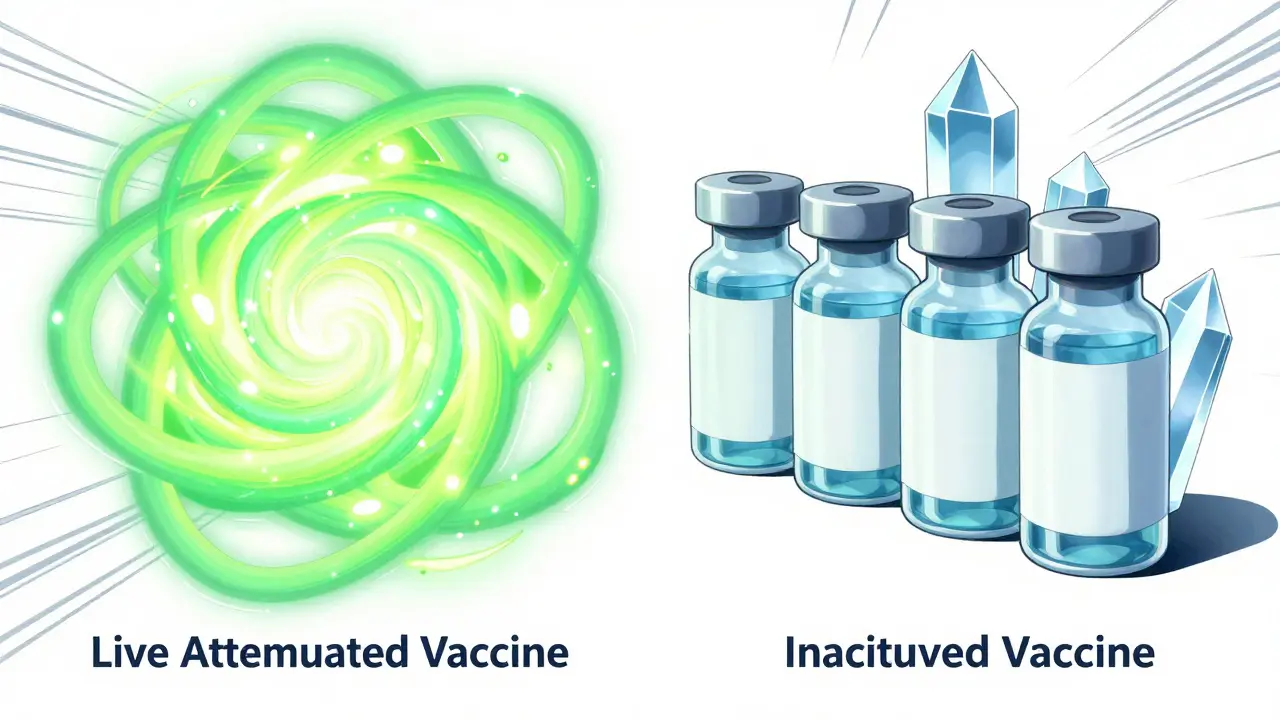
To understand the risk, you first need to know what is actually inside the syringe. Live Attenuated Vaccines is a type of vaccine that uses a weakened form of the germ that causes a disease. Because these vaccines contain a living (though weakened) virus or bacteria, they can occasionally replicate in people with very weak immune systems, potentially causing a full-blown infection.
On the other hand, Inactivated Vaccines are made from germs that have been killed or have had their essential parts removed. Since there is no living pathogen, these cannot cause the disease. They are generally safe for everyone, though the main drawback is that they might not trigger as strong of an immune response in someone whose system is suppressed.
| Feature | Live Attenuated Vaccines | Inactivated Vaccines |
|---|---|---|
| Safety | High risk; often contraindicated | Generally safe |
| Examples | MMR, Varicella, Nasal Flu (LAIV) | Hepatitis B, mRNA COVID-19, Shot Flu |
| Risk | Can cause vaccine-derived disease | Lower immune response (lower efficacy) |
| Dosing | Standard (if permitted) | Often requires extra doses/boosters |
Timing Your Vaccines with Treatment Cycles
Getting the right vaccine is only half the battle; timing is everything. If you get a shot while your immune system is at its lowest point, your body might not "notice" the vaccine, meaning you won't develop the antibodies needed for protection. Dr. Carlos del Rio from Emory University notes that the window for an optimal response is narrow and requires tight coordination with your treatment.
Depending on your medication, here are the general rules of thumb for timing:
- Before starting therapy: If you know you're starting immunosuppressants, try to get all your necessary vaccines at least 14 days before your first dose.
- During cyclical therapy: For those on chemotherapy or other cyclical drugs, the best time to vaccinate is often during the "nadir week"-the period between cycles when your white blood cell counts are beginning to recover.
- B-cell depleting therapies: If you are using agents like Rituximab or ocrelizumab, you generally need a 6-month gap after your last dose before getting a vaccine. The "sweet spot" for the best response is usually 3 to 6 months after the drug has cleared your system.
- Steroid use: If you are taking 20mg or more of prednisone (or equivalent) daily for two weeks or more, you should wait until your dose is reduced below 20mg/day before vaccinating if possible.

Specific Guidance for Common Vaccines
Not all inactivated vaccines are treated the same. Some require a more aggressive approach to ensure they actually work. For instance, the mRNA COVID-19 Vaccines (made by Pfizer-BioNTech and Moderna) are the gold standard for this group, but they are less effective here than in the general public. While a healthy person might have a 90%+ response rate, immunocompromised patients range from 15% to 85%.
Because of this lower efficacy, the ACIP recommends a modified schedule. Instead of a single annual shot, many immunocompromised adults are advised to get two doses of the latest vaccine to build stronger protection. It is also recommended to stick with the same manufacturer for the initial series to keep the immune response consistent.
For the flu, the rule is absolute: avoid the nasal spray (the live version) and always get the inactivated injection. For Hepatitis B, the standard 3-dose series (Engerix-B or Recombivax HB) is used, though a 2-dose series (Heplisav-B) is an option for those in healthcare settings.

The "Cocooning" Strategy
Since your own immune response to vaccines may be weaker, you can't rely solely on your own shots. This is where "cocooning" comes in. This strategy involves ensuring that everyone in your immediate circle-partners, children, and roommates-is fully up to date with their vaccinations. By creating a protective bubble of immune people around you, you drastically reduce the chance of a virus entering your home.
The data on this is compelling. A 2025 study showed that structured cocooning reduced household transmission to immunocompromised patients by 57%. If your partner gets the flu shot, they are significantly less likely to pass that flu to you, which is critical when your own vaccine might not provide 100% protection.
Practical Tips for Managing Your Schedule
Managing these timelines can feel like a full-time job. To avoid the frustration of pharmacy shortages or scheduling conflicts, consider these steps:
- Create a Shared Log: Keep a detailed record of your medication doses, the exact date of administration, and your vaccine history. This prevents the "accidental" administration of a live vaccine, which has happened in some clinical settings.
- Coordinate Your Team: Ensure your oncologist or rheumatologist is talking to your primary care doctor. The IDSA now provides decision support tools that help doctors map vaccines directly onto your specific medication cycle.
- Plan for the Surge: Don't wait until the peak of flu or COVID season. Schedule your vaccines during your treatment downtime *before* the winter surge hits, as pharmacies often run out of the latest formulations during peak demand.
Can I get the MMR vaccine if I am on low-dose steroids?
Generally, the MMR vaccine is contraindicated for immunocompromised patients because it is a live vaccine. However, if you are on very low doses of immunosuppressants, a medical specialist may determine the benefits outweigh the risks. You must have a specialist's approval before proceeding.
Why do I need more doses of the COVID vaccine than other people?
Immunosuppressants reduce your body's ability to create antibodies. Because the initial response is often weaker (sometimes as low as 15%), additional doses are required to "push" the immune system to recognize the virus and provide a meaningful level of protection.
What is the risk of a live vaccine if I take one by mistake?
The primary risk is vaccine-derived disease. Because your immune system cannot keep the weakened virus in check, the vaccine strain can replicate and cause the actual illness it was intended to prevent, which can be severe in immunocompromised individuals.
Should I stop my medication to get a vaccine?
Never stop your medication without consulting your doctor. While some patients report better antibody responses by skipping a dose (such as methotrexate), this must be managed by your medical team to ensure your underlying condition doesn't flare up.
Which COVID vaccine is best for me?
The mRNA vaccines (Pfizer-BioNTech and Moderna) have the most evidence supporting their use in immunocompromised populations. Novavax (protein-based) is a valid alternative if you cannot take mRNA vaccines.


